Select a site alphabetically from the choices shown in the box below. Alternatively, browse sculptural examples using the Forward/Back buttons.
Chapters for this volume, along with copies of original in-text images, are available here.


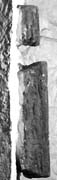
Object type: Two fragments probably of one cross-shaft
Measurements:
a (upper):
H. 22 cm (8.7 in); W. 26.5 > 22 cm (10.4 > 8.7 in); D. (after Collingwood 1915a) 20.3 cm (8 in), now built in
b (lower):
H. 65.6 cm (25.8 in); W. 31.8 > 30.5 cm (12.5 > 12 in); D. (after Collingwood 1915a) 15.2 cm (6 in) surviving, now built in
Stone type: 1a (upper): sandstone, pale-brown; 1b (lower): sandstone, pale-brown to ferruginous orange; both medium to coarse grained, quartzose and quartz cemented. Carboniferous sandstone, probably Millstone Grit Group. Nearest outcrops north of Leeds. [G.L.]
Plate numbers in printed volume: Ills. 425-8
Corpus volume reference: Vol 8 p. 182-3
(There may be more views or larger images available for this item. Click on the thumbnail image to view.)
A tapering rectangular cross-shaft, the visible angles edged with cable mouldings. The carving is flat and shallow, the background being simply hacked away around the figures and elements. The shaft is in a panelled style, the horizontal dividers being simple incised lines.
A (broad): A horizontal incised line at the top is a panel divider, but no trace of the ornament above this remains. (i) The upper surviving panel has a very stylised bush-scroll, of which the upper pair of volutes is more deeply carved than those lower in the panel, though all are modelled to some degree and not simply incised as in Collingwood (1915a, 201, figs. a, e). The only indication of a stem is between the upper pair of volutes. There are no traces of leaves or fruit. (ii) The second panel has an inner moulding, not complete on all edges. It is dominated by a crudely drawn frontal figure, his head overlapping the upper border, his arms pressed close to his sides and then extended to the edges of the panel from the elbow, breaching the inner moulding on the right. He wears a short tunic. Above his shoulders are frames like quarter circles fitting into the corners of the panel, enclosing a flat form of the same shape. Below his right arm an object with a curved stem and spear-shaped head points into his armpit, and there is something similar though with a less clearly defined head on the other side. A bar-like object crosses the panel beneath the figure's feet and extends up the sides of the panel until it meets the figure's hands. (iii) In addition to the lower moulding of the panel above, there is a narrow plain area at the top of the third panel, as though for an inscription, although no indication of one now remains. Although there are two curved elements in the panel, these are no longer legible. Collingwood (1915a, 201, fig. e) drew a large bird-like head in the top left corner, and described this panel as having two back-to-back dragons, but this cannot be confirmed.
B (narrow): There is no surviving ornament on either fragment. (This face cannot be photographed in its present position.)
C (broad): Both pieces now built into the wall. No ornament survived on the larger fragment, but the smaller apparently retained its cable moulding on both angles and had a double-stranded interlace showing one register of simple pattern E.
D (narrow): The cable-moulded arris survives on the right but only faint traces of ornament can be seen. There is a panel divider at the same level as the lower edge of the figural panel on face A.
Bailey (1980, 157–9), in a discussion of the difficulties of interpreting a number of late and crudely drawn scenes, gave Kippax as an example of one where we could not be certain of the sculptor's intentions for the figural scene. Later, however (Bailey 1996a, 80), he suggested that this is a rendering of the triumphal imagery of Psalm 90 (91), a reference to the figure of the faithful believer (often interpreted as pre-figuring Christ) trampling the lion and serpent underfoot. This is possible, but I would add that, although crudely drawn, the identification of the figural scene as a Crucifixion, with spear and sponge below the arms (without the figures of the bearers) and stylised sun and moon above, is possible. See, for example Kirkdale 1, east Yorkshire (Coatsworth 1979, I, 246–9; Lang 1991, 158–9, ill. 546) which possibly has this feature, and which also includes the treading of the serpents.
