Volume 8: Western Yorkshire
Select a site alphabetically from the choices shown in the box below. Alternatively, browse sculptural examples using the Forward/Back buttons.
Chapters for this volume, along with copies of original in-text images, are available here.
Current Display: Leeds 9, West Riding of Yorkshire


Overview
Object type: Inscription fragment [1]
Measurements: (after Stephens 1866–7) H. 25.5 cm (10 in); W. 29.2 cm (11.5 in); D. 20.3 cm (8 in)
Stone type: Not recorded
Plate numbers in printed volume: Ill. 516
Corpus volume reference: Vol 8 p. 207
(There may be more views or larger images available for this item. Click on the thumbnail image to view.)
Present Location
Lost
Evidence for Discovery
See Leeds 1. 'Found in 1837 in the north-east clerestory' (Stephens 1866–7, 487). First published by Haigh (1856–7) and also mentioned in R. D. Chantrell (1856–7, 537), but the location of this stone does not seem to have been known even at this time, as Haigh (1869–70, 214) makes it clear he did not see the stone himself. Page (1969, 36) speculates that the drawing published by Haigh (1873) may have been derived from Chantrell's own drawings from 1838. Haigh's brief mention (1856–7, 522) makes it sound as if he regarded it as part of Leeds (St Peter) 2, but no surviving fragment corresponds to his drawing.
Church Dedication
St Peter
Present Condition
Unknown
Description
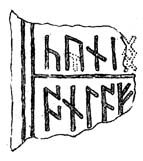
There appears to have been a double moulding on the left, but whether flat or rounded is not clear from the drawing.
E.C.
Inscription Surviving drawings of this fragment show two lines of Anglo-Saxon runes, set in a panel, and divided by a horizontal framing-line. They appear to read:
c u n i [ – ] | o n l a f [ – ]
D.N.P.
Discussion
It appears that the published engraving was drawn from Chantrell's work so is likely to be an accurate depiction of a genuine runic find.
E.C.
Inscription If they are accurately represented — and the forms are acceptable enough — the first three runes must suggest the word becun 'beacon, monument', so common on the group of vernacular memorial stones (Chap. VIII, pp. 79–82, esp. p. 81).
At face-value 'onlaf' is most intriguing: it could be taken as Onlaf, the regular English form of the Viking name that later became Old Norse Óláfr. If this identification were indeed correct, it would be highly interesting, placing what seems to be an Old English vernacular memorial stone into a period of cultural interaction with Scandinavian incomers, suggesting a dating to the later ninth century at the earliest (cf. the Crowle stone, Lincolnshire, dated by Everson and Stocker (1999, 151) to the tenth century). However, such a fragmentary piece, known only from drawings of uncertain accuracy, can hardly be conclusive on this point. See further Page 1969, 35–7 [1995, 166–7].
D.N.P.
Date
Possibly ninth to tenth century
References
Chantrell, R. 1856–7, 537; Haigh 1856–7, 522, no. 5; Haigh 1861, 42, pl. II, fig. 16; Stephens 1866–7, xxviii, 487–8, fig. on 487; Haigh 1869–70, 208–14; Haigh 1873, 254, fig. 2; Stephens 1884a, 215; Stephens 1884b, 154–5, fig. on 155; Allen and Browne 1885, 354; Browne 1885c, 155; Allen 1889, 208, 222; Allen 1890, 293, 297, 298; Allen 1891, 227, no. 2; Viëtor 1895, 21; Rusby 1896, 84; Collingwood 1912, 130; Browne 1915, 195–6; Collingwood 1915a, 218, 290; Collingwood 1915b, 272, 281, 285, 321, 322, 327 (Leeds VII); Browne 1916, 31; Arntz 1938, 89; Marquardt 1961, 89–90; Smith, A. 1962, 62n; Page 1969, 31, 35–7, 40; Page 1973, 31, 34, 134, 146, 217, fig. 8; McGuire and Clark 1987, 30–1, 47, no. 9, fig. 40; Page 1995, 163, 166–7, 169; Page 1999, 31, 34, 130, 144, 228, fig. 10; Parsons 1999, 76n; Page 2001, 102
Endnotes
[1] The following are general references to the Leeds stones: Pettigrew 1864, 308–9, 310–11; Bogg 1904, 75–6; MacMichael 1906, 363; Morris 1911, 46; Collingwood 1915a, 209–10, 292; Collingwood 1915b, 267–9, 271–2, 338; Collingwood 1927, 109; Faull 1981, 218; McGuire and Clark 1987, 5–9, 31–2, 42–5; Ryder 1993, 165.