Select a site alphabetically from the choices shown in the box below. Alternatively, browse sculptural examples using the Forward/Back buttons.
Chapters for this volume, along with copies of original in-text images, are available here.


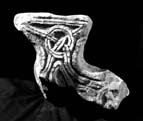
Object type: Part of cross-head [1]
Measurements: H. 19.5 cm (7.7 in); W. 21 cm (8.2 in); D. 16 cm (6.3 in)
Stone type: As Aberford (St Ricarius) 1, except that this fragment has been partly burnt to produce a pink colouration (5YR 7/4). [J.S.]
Plate numbers in printed volume: Ills. 9-11
Corpus volume reference: Vol 8 p. 89
(There may be more views or larger images available for this item. Click on the thumbnail image to view.)
A free-armed cross-head of type B10. Both broad faces are edged by a narrow flat moulding. The background is punched. The remains of the armpits are plain.
A (broad): A fine double strand follows the outline of the armpits and crosses in the middle of the surviving arm, where it threads through a loose double-stranded ring before again following the edge moulding of the end of the arm. An incomplete version of the same arrangement can be seen in the other arm. A second double strand emerges from the centre to follow the outline of the space left by the outer strand and its ring. Collingwood (1915a, 130, fig. a) reconstructed this as a petal-like feature emerging from a central boss, but it is more probable that it forms a right-angled crossing with strands from the upper and lower arms.
B and D (narrow): The surviving armpits are plain.
C (broad): This face clearly has paired double strands crossing from arm to opposite, not adjacent arm, and framing the centre. In the surviving arm these strands are joined by a short double bar, curve inwards to accommodate the armpit, enclose a loose pellet, and then cross to form a terminal Stafford Knot (simple pattern E) which fills the end of the arm.
The angular interlace crossing at a right-angle on either side of the centre is found on five heads in England, all in the West Riding — here at Aberford, and on Collingham 5, Kirkby Wharfe 1 and 3, and Saxton 1 (Ills. 164, 432, 440, 688). While there are Manx parallels for this and for the angularity of the design, both suggestive of a Norse-Irish connection, some modification from the local tradition, exemplified by the cross-head Ilkley 8C (Ill. 373), is also possible (see Chap. V, p. 49).
