Select a site alphabetically from the choices shown in the box below. Alternatively, browse sculptural examples using the Forward/Back buttons.
Chapters for this volume, along with copies of original in-text images, are available here.


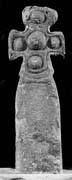
Object type: Cross-head and -shaft
Measurements: H. 112.5 cm (44 in); W. (head) 38.5 cm (15.2 in); (shaft) at foot 20 < 25.5 > 22 cm below head (7.8 < 10 > 8.7 in); D. (head) 18 cm (7.1 in); (shaft) 20 cm (7.8 in)
Stone type: Sandstone, pale grey, very coarse grained, silica cemented. Millstone Grit Group, local Chatsworth Grit. [G.L.]
Plate numbers in printed volume: Ills. 57-9
Corpus volume reference: Vol 8 p. 104
(There may be more views or larger images available for this item. Click on the thumbnail image to view.)
The cross-head and -shaft are carved in one piece, and the monument appears to be complete. The shaft has an entasis when viewed from the front but appears square in section viewed from the side.
A (broad): The shaft is completely plain. The head has side arms of type B10, but there is a more pronounced widening of the upper arm, though not of the most exaggerated 'hammerhead' form. It is outlined by a rather irregular groove. Within this the surface is slightly raised and left plain except for five large rounded bosses, one in each arm and one at the centre. There is evidence of a rudimentary 'collar' between the head and the shaft.
B and D (narrow): Both faces are completely plain.
C (broad): This face is now invisible, placed as it is very close to the wall.
The plainness and simplicity of this cross preclude any kind of close dating, unfortunately, since it is a rare complete example. Five bosses in this position possibly refer to the five wounds of Christ (Bailey 1980, 148–9), although it seems to me easier to see this as intentional on self-consciously designed early Anglo-Saxon jewelled crosses such as the pendant cross from the tomb of St Cuthbert or its pre-Viking sculptured parallels (Coatsworth 1989, 295–6). In this simpler work they certainly refer back to wooden prototypes with metal appliqués, or metalwork with real or dummy rivets, of which other examples in stone include cross-heads with the 'spine-and-boss' motif, as on Ripon 1 (Ill. 632). These features do not preclude an early date. Although very crudely done, however, this appears to be a form of 'round-shaft derivative' (Bailey 1980, 186–9), and this, together with the widening of the upper arm, places it most securely in the Anglo-Scandinavian period.
