Select a site alphabetically from the choices shown in the box below. Alternatively, browse sculptural examples using the Forward/Back buttons.
Chapters for this volume, along with copies of original in-text images, are available here.


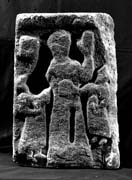
Object type: Architectural panel or panel from a cross shaft
Measurements: H. 59 cm (23.2 in); W. 41 > 38 cm (16.1 > 14.9 in); D. 20 > 18 cm (7.8 > 7.1 in)
Stone type: Sandstone, pale yellow, medium- to coarse-grained, quartz-cemented. Local Millstone Grit Group. [G.L.]
Plate numbers in printed volume: Ills. 74-8
Corpus volume reference: Vol 8 p. 106-7
(There may be more views or larger images available for this item. Click on the thumbnail image to view.)
The panel is dominated by three figures in a flat, heavy style in which elements such as the hands of the central figure are clumsily oversized. The scene is edged at the top by a heavy roll moulding, below which the face has been cut back quite deeply to a flat background. A central frontal figure in a long robe is the full height of the face as it survives. The lower edge of his robe and his feet are still just visible. A raised horizontal line low on his body may represent a girdle. From this depends a vertical slightly hollowed strip, but it is not clear whether this is original, intended to represent a fold, or perhaps to hold something inset, or is the result of later damage. No convincing traces of hair or facial features survive, but the shape of the head is a downward pointing ovoid. The figure's large left hand with outspread thumb is raised, possibly in a gesture of blessing; the position of his right arm and hand are not clear, but could be either reaching down and across his body to form part of or hold a circular object, which is also connected to one of the subsidiary figures.
On his right a smaller figure faces centre. He too wears a long robe below which his feet are quite clear. His head is damaged but appears to have been thrown back, as if looking upward. The area of damage extends up into the area above, in which is a square object with rounded corners, now indecipherable. His right arm is raised in front of his body, and he clearly grasps a scroll in his hand; his left arm reaches out to touch the side of the central figure.
The figure on the right of the panel is in three-quarter view and facing centre. He is robed. His feet are on a different plane from the other two figures. His pointed oval head seems to be thrown back as if looking up at the centre figure. His left arm is raised in front of his body, where he too seems to be holding a scroll, while his right arm reaches across the centre figure, to the large disc-like object which is possibly also the terminal of the central figure's right arm.
This scene, though somewhat more competently carved, may be compared to others with groups of three figures, such as those on Barwick in Elmet 2, Bilton in Ainsty 2, 3 and 4, and Royston 1 (Ills. 26, 39, 40, 53, and 684): for these a range of meanings has been suggested, some centring around events during the Arrest of Christ (Bilton in Ainsty 2 and 3); scenes possibly relating to the Fall (Bilton in Ainsty 4, Barwick in Elmet 2), and others less easy to pin down, such as Royston. Although superficially similar, however, there are features of the Bramham piece which suggest an ascription different from any suggested for the other stones. These features include the hand raised in blessing of the central figure, the long dress of the accompanying figures and their scrolls, and the fact that the central figure and the figure on his left are connected by an object held out by the one to the other. The disposition of the figures and their depiction suggests that this may be a Traditio Legis, in the western version further discussed under Dewsbury 1–3 below (p. 130), in which Christ gives the Law to St Peter, witnessed by St Paul (see Schiller 1986, pl. 577). The theme appeared a number of times on pre-Viking sculpture in Northumbria and Mercia, but the closely related theme of the Traditio Clavium, in which the keys are handed to St Peter and the book to St Paul, is also well-known from Irish sculpture (Harbison 1992, III, figs. 925–6, 928), so it may have again become influential in the Anglo-Scandinavian period. The flat style of carving and the varying size and plane of the figures also suggest the later period.
