Select a site alphabetically from the choices shown in the box below. Alternatively, browse sculptural examples using the Forward/Back buttons.
Chapters for this volume, along with copies of original in-text images, are available here.


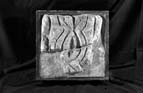
Object type: Fragment
Measurements: H. max. 33 cm (13 in); W. max. 33 cm (33 in); D. Unknown frame in which it is set measures 12 cm (4.7 in) in depth
Stone type: Sandstone, soiled, reddish to pale buff-brown, coarse to very coarse, quartzose, occasionally granular, with sparse quartz pebbles, quartz cemented. Carboniferous, Millstone Grit Group. [G.L.]
Plate numbers in printed volume: Ill. 801
Corpus volume reference: Vol 8 p. 275
(There may be more views or larger images available for this item. Click on the thumbnail image to view.)
The visible face shows two joining pieces of stone. It appears to have flat edge mouldings on two opposite sides, and may therefore represent one side of a shaft. Between these mouldings, two strands with incised outlines curve towards each other, meeting at a point, then out and in again to form one complete pointed oval, and at top and bottom, two incomplete ones. The central, complete oval encloses an inner closed pointed oval with a hollowed centre, and it seems the incomplete ones would have been the same.
Appendix A item (Stones dating from Saxo-Norman overlap period or of uncertain date)
The decoration as it stands is like no other pre-Conquest pattern, but it could possibly be an unfinished or bungled attempt at a double twist, found for example on Leeds 3 (Ill. 506) and Frickley 2 (Ills. 265, 267). Such twists, however, are usually found on the narrow faces of shafts, and here the width could imply a broad face.
