Select a site alphabetically from the choices shown in the box below. Alternatively, browse sculptural examples using the Forward/Back buttons.
Chapters for this volume, along with copies of original in-text images, are available here.


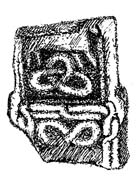
Object type: Upper part of cross-shaft(?) [1]
Measurements: (after Parez 1893) H. 41 cm (16 in); W. 30 cm (12 in); D. 15 cm (6 in)
Stone type: A light coloured stone' (ibid.)
Plate numbers in printed volume: Ill. 282
Corpus volume reference: Vol 8 p. 156
(There may be more views or larger images available for this item. Click on the thumbnail image to view.)
A (broad): In the upper part, within a double moulding, is a right-facing quadruped with a triquetra knot below, and beneath this a panel with an elaborate double moulding which apparently forms a twist at the sides and one element of a step pattern above. Within this panel is the termination of an interlace or twist.
C (broad) and B and D (narrow): Parez (1893, 90) said that 'on the other side of the fragment, similarly divided, is scrollwork, or knotted design. Part of the edge is also carved in like manner'.
Collingwood's drawing (1915, 176, fig. m) is a simple reworking of that in Parez (1893, fig. VII: see Ill. 282). Since both drawings appear to show a shallow step just above the level of the step pattern panel divider, it is possible that this was a fragment of a collared cross-shaft, or perhaps the top of a shaft and the lower part of a head. Parez's note that 'the panel beneath the Lamb is wider than the upper part' could support either possibility. The use of twists and step pattern to frame a panel is possibly a regional feature, perhaps inspired by the use of plant-scrolls to frame panels on, for example, the earlier cross-shafts Otley 1, face C (Ills. 552–4) and the lowest part of the shaft Collingham 1 (Ills. 166–9), where the border also clearly distinguishes a wider lower section of the shaft. A reflex of this can be seen in interlace panel dividers, see for example Ilkley 3 (Ill. 361), Collingham 2 (Ill. 170) and Collingham 4 (Ills. 157–60). The development of this divider into elaborate borders framing a panel or face can be seen on the shaft at Spofforth, 1A and C (tenth century, Ills. 708, 710).
The standing quadruped appears to relate this piece to Gargrave 1, but in its absence one has to be careful not to make too much of the piece with its very interesting border.
