Select a site alphabetically from the choices shown in the box below. Alternatively, browse sculptural examples using the Forward/Back buttons.
Chapters for this volume, along with copies of original in-text images, are available here.


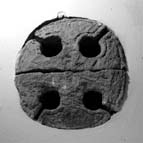
Object type: Cross-head in two halves, or halves of two similar cross-heads [1]
Measurements: H. 48.2 cm (19 in); W. 43.2 cm (17 in); D. Built in
Stone type: Sandstone, pale brown, medium to coarse, hard, well-cemented by quartz. Lower Coal Measures Group, Carboniferous. [G.L.]
Plate numbers in printed volume: Ill. 315
Corpus volume reference: Vol 8 p. 165-6
(There may be more views or larger images available for this item. Click on the thumbnail image to view.)
One or possibly two cross-heads of type E12, with the armpits fully pierced according to Collingwood (1915a, 185), although this is difficult to determine. Only one face is visible, and this is split horizontally across the centre: the two parts could be of the same head, but Ryder (1982, 111) thought the two halves too unequal to belong to the same cross. Neither part has an obvious link to the top of a shaft, and this might be thought to make it more likely that these are the top halves of two remarkably similar heads with almost circular armpits. The fragments seem exactly equal in width, however, and the side arms seem to belong together, with the horizontal split occurring just above the centre of the head. The face or faces are completely plain apart from the incised outline.
As Ryder (1982, 111) says, this form of head is closely paralleled in Galloway (as noted in Collingwood 1922–3, 220), which however also has close links with a group of monuments in Cumbria, the 'spiral-scroll school' (Bailey and Cramp 1988, 37–8), with which we have seen other links in the West Riding. See also Burnsall 7 (Ills. 105–8).
