Select a site alphabetically from the choices shown in the box below. Alternatively, browse sculptural examples using the Forward/Back buttons.
Chapters for this volume, along with copies of original in-text images, are available here.


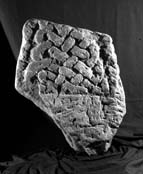
Object type: Part of shaft [1]
Measurements: H. 75 cm (29.5 in); W. 48 cm (19 in); D. 19 cm (7.5 in)
Stone type: Pale brown (5YR 5/2), fine- to coarse-grained (0.2 to 0.7 mm, but mostly medium-grained between 0.4 and 0.5 mm), sub-angular to sub-rounded, clast-supported, quartz sandstone. A few scattered, sub-rounded to rounded, pebbles up to 1.3 cm across. Chester Pebble Beds Formation?, Sherwood Sandstone Group, Triassic
Plate numbers in printed volume: Ills. 211-13
Corpus volume reference: Vol 9 p. 89
(There may be more views or larger images available for this item. Click on the thumbnail image to view.)
A (broad): Only the upper part of the stone is decorated. The ornament consists of six-strand plait with a worn cable-moulding border surviving to the right and left.
B (narrow): Step pattern, type 1, within cable-moulding borders
C (broad): There are traces of cabling on the arris border to the left of the decorated part of this face; the lower part is undecorated. Decoration consists of unidentifiable knotwork formed by a broad moulded strand.
D (narrow): Lost
Probably a circle-head (see Chapter V, p. 31). Like the other Neston stones, and fragments from Chester and West Kirby, the arris was boldly corded. Neston 3 and both Chester St John 1 and 3 — all circle-heads — leave the lower part of the stone uncarved, and the general shape of Neston 4 closely resembles those stones; the pattern on face C may have been similar to one used on Chester St John 3 (Ill. 87). Both the step pattern and the six-strand plait are common Viking-age motifs.
