Select a site alphabetically from the choices shown in the box below. Alternatively, browse sculptural examples using the Forward/Back buttons.
Chapters for this volume, along with copies of original in-text images, are available here.


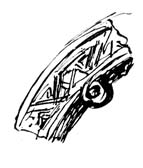
Object type: Part of cross-head [1] [2]
Measurements: The only information available refers to 'a portion of the ring of the circle which seems to have been over two feet in diameter' (Cox in BL Add. MS 37550, item 721; Cox, E. 1895, 238).
Stone type: Very hard red sandstone' (Cox in BL Add. MS 37550, item 721)
Plate numbers in printed volume: Ills. 651-2
Corpus volume reference: Vol 9 p. 240-1
(There may be more views or larger images available for this item. Click on the thumbnail image to view.)
This must rely upon earlier records. Cox's letter in BL Add. MS 37550, item 721, describes the head thus: 'On one side is a diagonal key pattern very well cut, and the other a guilloche with the triquetra at intervals on the same cord. Round the outside is a cable moulding and there is a [?] or cusp in the spandrel'. His drawing attached to this note shows the 'key pattern' as a zigzag pattern (Ill. 651). His later non-illustrated published account (1895, 238) adds that 'the spandrils are pierced and the circle ornamented with a very well-wrought diagonal pattern'. Taylor (H. 1906, 180) described the fragment as a 'circular head of a cross with cable moulding'.
Given what remains of the cross-head on the main shaft (Walton on the Hill 1), which is apparently free-armed, it seems likely that this fragment was part of a second carving and did not belong to the surviving sculpture.
The head was clearly large. Both the descriptions and Cox's drawing suggest that, though it had pierced spandrels, the ornament was strongly influenced by the circle-head group across the Mersey (see Chapter V, p. 31). Most of its decorative repertoire can be paralleled there: the cabled moulding on the rim of the circle at Bromborough 3, Chester St John 2 and West Kirby 3 (Ills. 36, 38, 82, 84, 354); some form of key-pattern on the circle at Hilbre Island 1 and Neston 2 (Ills. 172, 174, 205); the two-strand twist with triquetra (= Stafford knots) on several of the Chester pieces, though usually there on the outer rim (Ills. 92, 96, 114).
Where this head differs from all the rest of the circle-head group, and indeed from all other English carvings, is in the presence of a boss or billet on the inside of the circle. Something similar does occur once in Flintshire, on a cross which is also related to the Cheshire circle-head school, but there it is part of a trefoil piercing (Nash-Williams 1950, no. 185, pl. XXXIII). Several crosses in Cornwall equally have a boss/cylinder as part of a similar trefoil (Langdon 1896, 195, 196, 395, 396, 397, 399). Much more relevant to the Walton carving, however, are some 15 examples from Ireland which simply have a cylinder/boss set on the internal rim of the ring; most are of the tenth- or eleventh-century period but the list includes Durrow for which a ninth-century date now seems likely (Harbison 1992, ii, figs. 32, 115, 123, 126, 133, 184–5, 193, 247, 266, 318, 377, 500, 545, 618, 635, 640; Ó Murchadha and Ó Murchú 1988). Harbison (1992, i, 349) has argued that this feature derives from rivets in prototype bronze crosses, and suggests that the placing of the cylinder variously in the armpit or on the ring probably represents a workshop preference. In Ireland the distribution of this feature is markedly to the north and east — with some notable examples further south like Monasterboice. The single Scottish example from Iona, like this piece from Walton, should probably be seen as reflecting that Irish group (Fisher 2001, 134, fig. 28 (k); Calvert 1978, 104–6).
[1] The following is a general reference to the Walton stones: Blair 2005, 310.
[2] The following is an unpublished manuscript reference to no. 2: BL Add. MS 37550, items 721–2.
