Select a site alphabetically from the choices shown in the box below. Alternatively, browse sculptural examples using the Forward/Back buttons.
Chapters for this volume, along with copies of original in-text images, are available here.


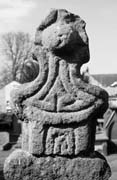
Object type: Part of cross-shaft and -head [1]
Measurements: H. 34 cm (13.5 in); W. (at base of head) 24 cm (9.5 in); D. 12.5 cm (5 in)
Stone type: Yellowish grey (5Y 7/2), well-sorted, clast-supported, fine-grained (0.2 mm) to medium-grained (0.4 mm), but mostly medium-grained at 0.3 mm, quartz sandstone. The clasts vary from sub-angular to sub-rounded. Millstone Grit, Carboniferous
Plate numbers in printed volume: Ills. 659, 671-4
Corpus volume reference: Vol 9 p. 244-5
(There may be more views or larger images available for this item. Click on the thumbnail image to view.)
A (broad, east): The remains of the shaft on this face show broad flat-moulding borders flanking a meander pattern. The surviving lower arm of the head is fan-shaped with its curved terminal forming a border with the top of the shaft (type E9). At the centre of the head was a boss with a hole pierced in its centre. The lower arm is decorated by strands which flank the border and join in an arrow-like form at the centre.
B (narrow, north): A bold roll-moulding runs up the centre of the shaft and terminates in a boss just below the cross-arm.
C (broad, west): The borders on the shaft and head are as on face A but the boss on the cross-head is much more conical than on the other side and seemingly lacked any drilled hole. There is a vertical moulding springing from the boss into the fragmentary remains of the upper arm, whilst the lower arm carries an angular version of a triquetra whose crossing strands meet in a flat boss. The decoration on the shaft is now uncertain but is likely to have been some form of meander pattern.
D (narrow, south): As face B
Collingwood (1927a, fig. 132) suggested that this head belonged with Whalley 1. There is no reason to accept this. Rather, its associations are with the group formed by Whalley 3, Bolton le Moors 1 and 7 and the Anderton carving (see Chapter V, p. 37). With Whalley 3 it shares the arrow-like key pattern on the head (Ill. 677) and the mouldings ending in a boss of faces B and D (Ills. 676, 678), whilst the shaft pattern on face A appears to be a version of the variant meander pattern employed on Anderton 1 and Bolton 1 (Ills. 402, 411). The form of head falls into the 'penannular' group so popular in the Pennine area (see Chapter V, p. 33).
[1]. The following are general references to the Whalley stones: Whitaker 1800–1, 31–2, 33, 37, 297; Whitaker 1818, 49–51, 250; Baines 1831–6, III, 178–9, 383; Baines 1868–70, II, 8; Whitaker 1872–6, I, 69, 71, II, 15, 157, 557, pl. facing 1; Croston 1884a, 4–5; Croston 1884b, 3; (–––) 1885b, 228; Allen and Browne 1885, 355; Browne 1885b, 156–7; Browne 1887a, 12–14; Jackson 1889, 34; Glynne 1893, 79; Harrison 1896, 4; Howarth 1899, 9; Farrer and Brownbill 1911c, 355; Fishwick and Ditchfield 1909, I, 5; Wallis 1921; Brown, G. 1937, 274; Tupling 1948, 6, 8; Edwards, B. 1975; Edwards, B. 1978a, 72–5; Fellows-Jensen 1985, 407; Edwards, B. 1992, 58; Panikkar 1994, 20; Crosby 1998, 30; Noble 2004, 75–81.
The following are unpublished manuscript references: BL Add. MS 37550, items 724–35; BL Add. MS 37551, items 76–9; Lancashire Record Office, DP 291/61–62 and 292/1; Lancashire Record Office DP 386/8.
