Select a site alphabetically from the choices shown in the box below. Alternatively, browse sculptural examples using the Forward/Back buttons.
Chapters for this volume, along with copies of original in-text images, are available here.


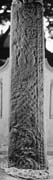
Object type: Part of shaft [1]
Measurements: H. 157 cm (62 in); W. 37 > 30.5 cm (14.5 > 12 in); D. 24 > 21 cm (9.5 > 8.25 in)
Stone type: Greyish orange pink (5YR 7/2), poorly sorted, clast-supported, fine- (0.2 mm) to very coarse-grained (2.0 mm), but mostly medium- to coarse-grained between 0.4 and 1.0 mm, quartz sandstone. The clasts vary from sub-angular to sub-rounded. Millstone Grit, Carboniferous
Plate numbers in printed volume: Ills. 679-81
Corpus volume reference: Vol 9 p. 248-9
(There may be more views or larger images available for this item. Click on the thumbnail image to view.)
The vertical frames on all surviving faces consists of a row of pellets set between the flat outer moulding and a narrow inner border. On face A there are no clear horizontal mouldings separating the different ornaments.
A (broad, west): At the top of the surviving shaft is a panel containing a half pattern B knot formed by median-incised strands. Below are irregular serpentine forms set over two human figures. These are forward facing with arms by their sides; the shape below their waist suggests that they were dressed in full-length garments. Both appear to be haloed. The stone is badly worn immediately below the figures but, towards the base of the shaft, there is a regular eight- or ten-strand plait above a more complex half pattern.
B (narrow, south): Only faint traces of knotwork panels within the pelleted border remain.
C (broad, east): Lost
D (narrow, north): The right-hand vertical border, with its pellets, remains. At the top of the shaft is a panel of open four- or six-strand plait. The panels immediately below this are now heavily worn but, at the base, there are traces of knotwork involving encircled crossings.
The worn nature of the carving poses problems about identification of patterns and thus of dating and interpretation. At different times, for example, scholars have seen scrollwork, snakes and chain patterns on the stone — none of which can now certainly be identified (Browne 1887a, pl. III, fig. 1; Taylor, H. 1906, 80; Edwards, B. 1989b, 29).
The bossed outline is strongly reminiscent of metalwork techniques of the type seen for example on the Rupertus cross, Ormside bowl and Winchester reliquary (Webster and Backhouse 1991, nos. 133, 134, 136). In this respect the shaft reflects the same tastes as Whalley 3 and Eccleston 1 (Ills. 454–7, 675–8). Similar bossing, again metalwork inspired, is found on Yorkshire carvings (Lang 1991, 40, ills. 221, 264, 267, 269, 273, 347; id. 2001, ills. 450, 1116). Dating to the Viking period is assured by the presence of a loose ring in the knotwork on face D.
The figures on face A are difficult to interpret. Edwards (B. 1989b, 29) suggested that they might have been intended as Adam and Eve, but that interpretation depends on the dubious presence of branches or snakes amidst the worn ornament over their heads. If both are haloed then they presumably represent saints but no further explanation is now possible. It should be noted, however, that a somewhat similar type of near-ornamental twinning of figures occurs among Tees valley sculptures, though in that case the motif seems to be imitative of an earlier monument in the area (Cramp 1984, pls. 6.21, 8.27, 11.33, 12.39, 12.43, 14.61, 14.63; Lang 2001, ills. 278, 400; Bailey 1980, 191–4).
[1]. The following are general references to the Whalley stones: Whitaker 1800–1, 31–2, 33, 37, 297; Whitaker 1818, 49–51, 250; Baines 1831–6, III, 178–9, 383; Baines 1868–70, II, 8; Whitaker 1872–6, I, 69, 71, II, 15, 157, 557, pl. facing 1; Croston 1884a, 4–5; Croston 1884b, 3; (–––) 1885b, 228; Allen and Browne 1885, 355; Browne 1885b, 156–7; Browne 1887a, 12–14; Jackson 1889, 34; Glynne 1893, 79; Harrison 1896, 4; Howarth 1899, 9; Farrer and Brownbill 1911c, 355; Fishwick and Ditchfield 1909, I, 5; Wallis 1921; Brown, G. 1937, 274; Tupling 1948, 6, 8; Edwards, B. 1975; Edwards, B. 1978a, 72–5; Fellows-Jensen 1985, 407; Edwards, B. 1992, 58; Panikkar 1994, 20; Crosby 1998, 30; Noble 2004, 75–81.
The following are unpublished manuscript references: BL Add. MS 37550, items 724–35; BL Add. MS 37551, items 76–9; Lancashire Record Office, DP 291/61–62 and 292/1; Lancashire Record Office DP 386/8.
