Select a site alphabetically from the choices shown in the box below. Alternatively, browse sculptural examples using the Forward/Back buttons.
Chapters for this volume, along with copies of original in-text images, are available here.


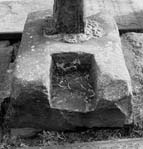
Object type: Double socket-stone [1]
Measurements: H. 42 cm (16.5 in); W. 126 cm (49.5 in); D. 79 cm (31 in); The empty socket is 37 x 32 cm (14.5 x 12.5 in) and 19 cm (7.5 in) deep
Stone type: Yellowish grey (5Y 7/2), moderately sorted, clast-supported, fine-grained (0.2 mm) to medium-grained (0.5 mm), but mostly medium-grained between 0.3 and 0.5 mm), quartz sandstone; scattered small flakes of white mica. Millstone Grit, Carboniferous
Plate numbers in printed volume: Ills. 706-7
Corpus volume reference: Vol 9 p. 253-4
(There may be more views or larger images available for this item. Click on the thumbnail image to view.)
The stone is roughly squared and the unfilled socket is half cut away.
Double socket-stone (see Chapter V, pp. 37–8: there is no evidence that there were once three sockets on this stone as claimed by Taylor, H. 1906 and Garstang 1906 — see above). Haslingden 1 and Stretford 1 provide further Lancashire examples of this type of base (Ills. 506–7, 649–50), and there may have been others at Cheetham Hill and Rochdale (see discussion of Haslingden 1, p. 196). This double socket, like Haslingden, is a rare example of the type in that it apparently came from a churchyard.
[1]. The following are general references to the Whalley stones: Whitaker 1800–1, 31–2, 33, 37, 297; Whitaker 1818, 49–51, 250; Baines 1831–6, III, 178–9, 383; Baines 1868–70, II, 8; Whitaker 1872–6, I, 69, 71, II, 15, 157, 557, pl. facing 1; Croston 1884a, 4–5; Croston 1884b, 3; (–––) 1885b, 228; Allen and Browne 1885, 355; Browne 1885b, 156–7; Browne 1887a, 12–14; Jackson 1889, 34; Glynne 1893, 79; Harrison 1896, 4; Howarth 1899, 9; Farrer and Brownbill 1911c, 355; Fishwick and Ditchfield 1909, I, 5; Wallis 1921; Brown, G. 1937, 274; Tupling 1948, 6, 8; Edwards, B. 1975; Edwards, B. 1978a, 72–5; Fellows-Jensen 1985, 407; Edwards, B. 1992, 58; Panikkar 1994, 20; Crosby 1998, 30; Noble 2004, 75–81.
The following are unpublished manuscript references: BL Add. MS 37550, items 724–35; BL Add. MS 37551, items 76–9; Lancashire Record Office, DP 291/61–62 and 292/1; Lancashire Record Office DP 386/8.
