Select a site alphabetically from the choices shown in the box below. Alternatively, browse sculptural examples using the Forward/Back buttons.
Chapters for this volume, along with copies of original in-text images, are available here.


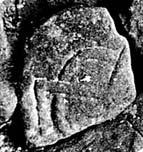
Object type: Possible grave-marker [1] [2]
Measurements: (after Cox in Allen 1895, 164). H. 22.5 cm (9 in); W. 30.5 cm (12 in); D. not known
Stone type: Unobtainable
Plate numbers in printed volume: Ills. 53-4
Corpus volume reference: Vol 9 p. 56
(There may be more views or larger images available for this item. Click on the thumbnail image to view.)
Cox's drawing (Allen 1894, pl. XIII (5)) and the British Museum photographs show a stone, with rounded edge or top, carrying relief decoration which appears to consist of angular mouldings outlining a wedge-shape to the left and parts of a similar form to the right; these overlie a curved moulding.
The stone was probably a round-headed grave-marker (see Bromborough 7 above) but its openwork decoration is difficult to reconstruct. To Cox it seemed that the design involved a Maltese cross, but equally it could have consisted of some form of angular trefoil, linked by a central ring.
[1] Most of the pre-Norman sculpture from this site has been lost. Its original discovery and subsequent history are recorded in a letter dated 13 May 1936, to the editor of the Bebington News, from Mrs A. Anderson, a copy of which is preserved in the files of the former Department of Medieval and Later Antiquities (now Prehistory and Europe) in the British Museum. This states that the stones were found in 1863 when the church — itself built in 1828 — was demolished; they had apparently been used in its foundations. The carvings were then placed in a pile on the lawn of the Rectory garden. This assemblage, of which photographs survive in the British Museum departmental files (Ills. 43–57), was dispersed in 1909. The transom fragment (Bromborough 3) along with two shaft fragments (no. 1) were then placed on the windowsill in the south porch of the church; a fragment of an 'upright grave cros' was set on the windowsill of the north porch, and the rest were distributed around the walls and rockeries of the Rectory. In May 1933 there was a proposal to develop the Rectory site and the Bromborough Society tried to intervene to save the stones. The Society was rebuffed and the builder who took over the property subsequently claimed not to have recognised any carvings. It was at this stage that most of the sculpture seems to have been destroyed. The later treatment of the surviving stones is described below.
[2] The following are general references to the Bromborough stones: Ormerod 1875–82, III, 899; (–) 1890, 250; Cox, E. 1895, 242–3; Anderson, A. 1934; Sylvester and Nulty 1958, 14; Higham, N. 1993b, 132. The following is an unpublished manuscript reference: BL Add. MS 37547, item 653 (Romilly Allen collection).
