Select a site alphabetically from the choices shown in the box below. Alternatively, browse sculptural examples using the Forward/Back buttons.
Chapters for this volume, along with copies of original in-text images, are available here.


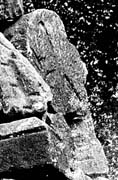
Object type: Disc-headed grave-marker
Measurements: (after Cox in Allen 1895, 164); W. 48 cm (19 in); D. not known
Stone type: Unobtainable
Plate numbers in printed volume: Ills. 378-9
Corpus volume reference: Vol 9 p. 140
(There may be more views or larger images available for this item. Click on the thumbnail image to view.)
This stone is not clearly identifiable in the surviving photographs — though it may be recognisable as Bromborough 12 in the British Museum photograph of the Rectory Garden assemblage (Ills. 43–4) — but Cox's drawing shows a circular head with a fragment of shaft or base below (Allen 1894, pl. XIII, 4). The cross (type E8) is formed by four ovate sunken panels.
Appendix A item (stones dating from Saxo-Norman overlap period or of uncertain date)
Though round-headed grave-markers are known from both early and late dates within the pre-Conquest period (Cramp 1984, 7), forms with a short shaft and discoid head seem to be of eleventh- and twelfth-century date. None occur with characteristic Anglo-Saxon ornament like interlace, scrolls or animals. Well-dated examples have come from the pre-1178 graveyard under Newcastle castle and from the foundations of the church of c. 1150 at Adel in west Yorkshire (Cramp 1984, 244–5, pls. 247.1370, 248.1371; Ryder 1991, 8–9, 50; Coatsworth 2008, 271–3, ills. 784–95); others have been published from Northumberland, Co. Durham, Yorkshire, Cumbria, Lincolnshire, Derbyshire and Gloucestershire which offer analogies for the Bromborough form (Cramp 1984, pls. 232.1314, 234.1325, 258.1403; Lang 2001, ill. 1132; Everson and Stocker 1999, 275; Bailey and Cramp 1988, ills. 624–7; Butler and Jones 1972, pl. I (ii); Ryder 1985, pl. 48; id. 1991, 8–9, 12, 22, 36, 41; id. 2000, 82, 90, 100, 109; id. 2001, fig. 11; id. 2002, 136). In Scotland, Fisher (2001, 17, figs. on 58) has listed similar carvings for which an eleventh-century date, based on Northumberland parallels, is proposed. Altham provides two further regional examples of the form; so also, probably, do Heysham 9, Swettenham 1 and Woodchurch 1 (Ills. 381, 382, 527, 719–22). Specific parallels for this form of cross on a discoid head are, however, elusive, Birtley 4 in Northumberland perhaps providing the closest analogue (Cramp 1984, pl. 234.1325–7). Cox (in Allen 1894, 29) drew attention to a similar carving in the tower turret at the nearby church of St Helen's, Sefton.
