Select a site alphabetically from the choices shown in the box below. Alternatively, browse sculptural examples using the Forward/Back buttons.
Chapters for this volume, along with copies of original in-text images, are available here.


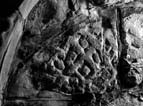
Object type: Fragment
Measurements: H. 24 cm (9.5 ins); W. 33 cm (13 in); D. Built in
Stone type: Inaccessible
Plate numbers in printed volume: Ill. 376
Corpus volume reference: Vol 9 p. 141
(There may be more views or larger images available for this item. Click on the thumbnail image to view.)
All that is visible are the crossing lines of relief plaitwork with raised diamonds between the intersections.
Appendix A item (stones dating from Saxo-Norman overlap period or of uncertain date)
This stone, like those forming Bruera 3–6, is not necessarily in its original position. Though simple plait occurs in a ninth-century context at Rothbury, Northumberland (Cramp 1984, pl. 214.1222), it is more characteristic of Viking-age carvings: the western area of Yorkshire provides many examples (Coatsworth 2008, ills. 3, 23, 37, 48–9, 438, 442, 710). The addition of pellets or other decoration in the intersections can be paralleled in various areas at a variety of dates — see Hornby 1 and 2, and carvings from Galloway, Wales and Yorkshire (Ills. 549, 554; Collingwood 1922–3, figs. IV, XII; Nash-Williams 1950, no. 212, pl. LXVI (4); Lang 2001, ills. 722, 848). In his analysis of the doorway, however, Baxter (2004b) argues that the decoration is identical to that on the jamb stones of the external face which he sees as part of the twelfth-century construction.
