Select a site alphabetically from the choices shown in the box below. Alternatively, browse sculptural examples using the Forward/Back buttons.
Chapters for this volume, along with copies of original in-text images, are available here.


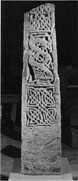
Object type: Almost complete cross-shaft, in two joining pieces [1]
Measurements: H. 132 cm (52 in); W. 30.5 > 22.3 cm (12 > 8.75 in); D. 20.5 > 15.8 cm (8 > 6.25 in)
Stone type: Medium-/coarse-grained, massive yellow sandstone
Plate numbers in printed volume: Pls. 37.189-190, 38.191-192
Corpus volume reference: Vol 1 p. 66-67
(There may be more views or larger images available for this item. Click on the thumbnail image to view.)
The shaft is edged with a flat-band moulding and divided into panels by fine horizontal roll mouldings. Its base is plain. The cutting of the ornament is deep in a good over and under technique.
A (broad): (i) A slightly crooked but confidently cut incomplete panel of split plait. (ii) Two ribbon animals with interlaced limbs. The details are very worn but each seems to have its front leg upraised, one back leg through the mouth of the other beast, and tail extended to twist between the bodies and to run alongside the upraised front leg of the opposing beast before joining its ear extension. The jaws of each beast are twisted to form a double loop. (iii) Two registers of double-stranded simple pattern E.
B (narrow): A continuous changing interlace: at the top two registers of alternating half pattern D which merge into seven registers of complete pattern B, an eight-cord pattern.
C (broad): (i) This has been called by Adcock (1974, 213) `pattern C with outside strands and capricious breaks'. The pattern is very worn at the top but has clearly been adapted cleverly to fit the taper. In the lower register the strand on the right has been thickened to fit the space almost to the width of the beasts in the panel below. (ii) A composition of two serpentine creatures with beaked heads. Their bodies cross below the centre of the panel; their heads curl inwards and then out towards the lower corners. At the top what appear to be their tails curl round in a spiral. Fine strands extend from the extremities and heads to form an infilling interlace.
D (narrow): Six registers of complete and closed circuit pattern D, mixed.
This cross poses one of the most difficult chronological problems of all the Durharn pieces. I have discussed them at length elsewhere (Introduction, p. 32; Cramp 1966; Cramp 1980). Greenwell's reaction that it should be placed in the ninth century (Greenwell 1890-5c, 282), and Kendrick's first date (1938, 137) in the mid eighth, conflict with Collingwood's (1927, 133) and Kendrick's revised date (1949, 95) as belonging to the tenth- to eleventh-century revival. Since then Adcock has placed it in the ninth century (1974, 209-15), and most recently Morris (1978, 103-4) has suggested that Aycliffe 1, and by implication the St Oswald's cross, is mid tenth century. There are undeniably `early' characteristics of this piece which could place it in an eighth-/ninth-century Bernician context: the square-sectioned shaft; the geometric interlace; the animals and snakes composed on a grid (Adcock 1974). Nevertheless the split plait seems to be a late ninth-century phenomenon (Introduction, p. 18) and the twisted jaws of the animals on face A seem to be here, as on the Tynemouth 1 and Aycliffe pieces, an Anglo-Scandinavian motif (contrast Lindisfarne 1). The lack of comparable monuments at Chester-le-Street, either in technique or stylistic elements (save the split plait of no. 1), together with the fact that Durham 2-3 are like Chester-le-Street, seems to rule out Chester-le-Street as the influential centre. The grave-cover from Durham (no. 11), which is clearly based on the Durham peninsula, repeats several of the St Oswald's 1 patterns in the harder, more academic manner of Aycliffe 1. I feel that this piece is best seen as a conscious revival or commemorative copy; this is supported by the lop-sided pattern which could have been stencilled from another monument. The Lindisfarne reminiscences which are not exactly paralleled on the surviving stones on the island could be explained by the influence of Aethelwold's cross, which surely when it was set up as the first monument in the churchyard on the peninsula, must have been very influential. The links with the Monk's Stone at Tynemouth (no. 1) and Tynemouth 4 are more difficult to explain, but the Monk's Stone, which must have been an impressive monument and was certainly a landmark (see Tynemouth 1), could have served as a model for Durham 1, as it did for later Tynemouth pieces.
