Select a site alphabetically from the choices shown in the box below. Alternatively, browse sculptural examples using the Forward/Back buttons.
Chapters for this volume, along with copies of original in-text images, are available here.


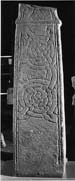
Object type: Shaft and part of head of cross [1]
Measurements: H. 148 cm (58.25 in); W. 45.7 > 36.1 cm (18 > 14.5 in); D: (to below head). 23 > 21 cm (9 > 8.25 in)
Stone type: Medium-grained, bedded greyish yellow sandstone
Plate numbers in printed volume: Pls. 39.193-194, 40.195-196
Corpus volume reference: Vol 1 p. 67
(There may be more views or larger images available for this item. Click on the thumbnail image to view.)
Each broad face is edged with a broad outer roll moulding and a fine inner roll moulding. The narrow faces have a grooved moulding. The mouldings extend nearly to the base of the shaft but the patterns are on the upper half. The carving is all in a grooved technique. The head is formed from the same block as the shaft and tapers from a slight shoulder.
A (broad): The crossing tips of two closed circuit loops survive on the head. The shaft has two registers of a pattern with three circles crossed by two closed circuit loops which act as long diagonals, a form of ring-knot.
B (narrow): The head appears to be plain above the moulding. An irregular knot pattern fills the upper half of the stone with a horizontal grooved moulding at its base. The pattern is composed of two long diagonal closed circuit loops, which are in three places interlaced and linked by a free ring. The spaces between the rings are filled by a shallow pseudo-strand of a ribbon-like type and the strands on either side are clipped together.
C (broad): The base of the head has two closed circuit loops. On the shaft the pattern is the same as on face A, save that the strands are encircled with two rings. Below is a horizontal grooved moulding.
D (narrow): The head appears to be plain above the moulding. As on face B there are three foci where the long diagonals are encircled and interlaced. Here, however, the knots are formed by the central strand branching and then coming together to re-form as a single strand.
Despite the unfinished appearance of this shaft there seems little doubt that it is complete, and in the tradition of the Lindisfarne shafts and Durham 1, where the lower portions of the shafts are left uncarved. The large sprawling patterns of ring-knots and branching patterns are also found on Chester-le-Street 11. This branching pattern like that on Bywell I seems to be a misunderstood rendering of the Anglo-Scandinavian ring-chain (Introduction, p. 18). These pieces from St Oswald's (nos. 1 and 2) have also been compared with a now missing shaft from Jarrow (no. 6: Adcock 1974, 321). Durham 4 could be the head of this cross.
