Select a site alphabetically from the choices shown in the box below. Alternatively, browse sculptural examples using the Forward/Back buttons.
Chapters for this volume, along with copies of original in-text images, are available here.


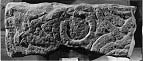
Object type: Part of cross-head [1]
Measurements: H. 23 cm (9 in); W. 53.3 cm (21 in); D. 17.8 cm (7 in)
Stone type: Medium-grained, bedded yellow sandstone
Plate numbers in printed volume: Pl. 43.201-204
Corpus volume reference: Vol 1 p. 68
(There may be more views or larger images available for this item. Click on the thumbnail image to view.)
The stone seems to have been reused as a building stone, so that it is difficult to determine the head type. It could be A9 or B10. Only the broad faces are carved. In the centre of the head there seems to be a roughly cut sunken field surrounded by a circular roll moulding. On the arms strands of interlace appear to divide two-by-two around the centre. The strands are wide and cut in a shallow grooved technique. They could terminate in a pattern E knot.
The sunken bossed centre is not as common as those with a rounded boss, but the formula of surrounding the boss with simple strands of interlace with pattern E elements is found on several sites, such as Hexham (no. 11), and Darlington (nos. 1-2). This head could belong to Durham 2.
