Select a site alphabetically from the choices shown in the box below. Alternatively, browse sculptural examples using the Forward/Back buttons.
Chapters for this volume, along with copies of original in-text images, are available here.


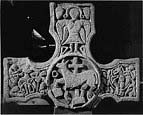
Object type: Part of cross-head [1]
Measurements: H. 64 cm (25.25 in); W. 84.5 cm (33.25 in); D. 15.9 cm (6.25 in)
Stone type: Coarse-grained, massive yellow/grey sandstone
Plate numbers in printed volume: Pls. 43.205, 44.206-208
Corpus volume reference: Vol 1 p. 68-69
(There may be more views or larger images available for this item. Click on the thumbnail image to view.)
Head, type D11. It is elaborately and deeply carved on the narrow as well as the broad faces and is edged by a flat-band moulding.
A (broad): Encircled by an internal fine roll moulding which follows the outlines of the upper arm and half-way along the horizontal arms. In the centre is a Lamb surrounded by a roll moulding. The Lamb faces left and is shown in movement with its right front foot raised and resting on a rectangular object. Its head is uplifted; it has an oval eye and sharply pricked ears; its feet have three toes and its fleece is lightly marked. In front of its neck is a circular object and behind its body is a shafted cross, type A1, set in a base decorated with grooved double mouldings. In the upper arm, standing on the circular central frame with feet out-turned, is a frontal winged figure. He has a wedge-shaped head with lightly incised features; surrounding his head is a detached halo with curling ends or hair. He has two pairs of wings and what may be a short right arm held across his chest. He is dressed in a short tunic with flaring hem. On either side of his head are two detached human heads facing outwards; that on the left is quarter-turned, that on the right half-turned. At the feet of the winged man are two raised triangular features. On the left arm a smaller winged creature stands frontally in the middle of the composition. Its beast's head is turned to the right, and across its body is a strand-like feature. To its right are two busts of angels, the one above possibly holding a book, the one below a scroll. On the left there appear to be a similar winged bust and, above, a perching bird or beast. On the right arm the central figure is frontal and winged; it has a beast's head of canine type with pricked ears, facing left. Its tongue extends into a strand which encircles its body and disappears behind its wing. On the top right is an angel holding a scroll, on the bottom right a bird possibly holding a book. On the left is a strange monkey-like creature and what may be another angel.
B (narrow): On the edge of the upper arm a register of closed circuit pattern D with bar terminals; on the lower, two registers of closed circuit pattern D with bar terminals.
C (broad): In the centre roundel is what seems to be a baptism scene surrounded by a roll moulding. In the centre a bare-legged frontal figure holds up in his left hand a long-handled object with a circular end. Bending before him (from the right) is a side-facing figure, his hand held below his chin as though he is praying. He appears to be wearing a short tunic. On the left is a three-quarter frontal figure slightly inclined to the centre and holding a book in his right hand. On the upper arm is a large bird on a perch. Its wings are displayed and its tail prominently fanned; its head is turned to the left and it appears to have something in its beak. It has three-clawed feet. On the right of its head is a detached human head three-quarter turned, on the left an angular crescent.On the left arm are two frontal figures. The one on the left has an exaggerated right shoulder and holds a shafted cross (type A1) in his right hand, and a book in his left. He has an egg-shaped head like all the other figures on this face, with features lightly conveyed. He is swathed in a pleated robe. To his right is a more indistinct figure holding a book in both hands. On the right arm is an identical composition, except for an additional triangular feature in relief between the inner figure and the roundel.
D (narrow): On the upper arm, three registers of complete pattern A; on the lower arm, two registers of a ring-knot pattern, in which double rings are crossed by two closed circuit loops.
See no. 7.
