Select a site alphabetically from the choices shown in the box below. Alternatively, browse sculptural examples using the Forward/Back buttons.
Chapters for this volume, along with copies of original in-text images, are available here.


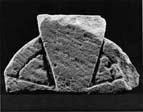
Object type: Cross-head, part of grave-marker(?) [1]
Measurements: H. 18 cm (5 in); W. 30.1 cm (13 in); D. 11.5 cm (4.5 in)
Stone type: Medium-grained, massive yellow sandstone
Plate numbers in printed volume: Pl. 150.787-789
Corpus volume reference: Vol 1 p. 152
(There may be more views or larger images available for this item. Click on the thumbnail image to view.)
This cross-head, which seems to be part of a head- or foot-stone to mark a grave, is carved from a solid disk, in which the upper arm projects from the circular faces on which the cross shape is outlined.
A (broad): A cross, type B6, with ring, type d, with unpierced spandrels, is incised on the disk. Only the upper vertical arm is complete and projects from the rim. The upper line only of the horizontal arms survives. The outline is formed by using a punch with a point about 2 mm wide. One section of the outline has been bungled and repeated. The tops of the arms and the outer curve of the ring are finished with a broad-bladed chisel. The under surface is broken off.
B and D (narrow): Plain.
C (broad): The shape of the cross is very similar to that on A, but the vertical arm is wider and the gaps between it and the horizontal arms are more irregular.
Appendix A item (stones dating from Saxo-Norman overlap period or of uncertain date).This seems to be part of a grave-marker assemblage, in which the short cross would be placed at one or both ends of a flat slab (see Whitby, Pl. 263, 1424). The shape of the cross could have developed in the pre-Conquest period, but this form of short block-like grave-marker is best seen in the `overlap' or early Romanesque period (Cramp and Douglas-Home 1980, 228, pl. 14B).
