Select a site alphabetically from the choices shown in the box below. Alternatively, browse sculptural examples using the Forward/Back buttons.
Chapters for this volume, along with copies of original in-text images, are available here.


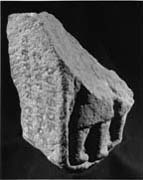
Object type: Fragment [1]
Measurements: H. 22.9 cm (9 in); W. 15.3 cm (6 in); D. 10.2 cm (4 in)
Stone type: Coarse-grained, massive yellow sandstone
Plate numbers in printed volume: Pl. 48.229, 48.231-232
Corpus volume reference: Vol 1 p. 74
(There may be more views or larger images available for this item. Click on the thumbnail image to view.)
A (broad): Edged with a deep roll moulding which returns along the base of a panel containing the lower half of two figures. On the left the figure faces right and has a short skirt and short thick legs; a similar figure faces left, but only one leg survives.
B (narrow) and C (broad): Broken away.
D (narrow): Dressed smooth.
It is not clear whether this piece was part of a cross or of a panel, but it is a relatively large-scale carving. The deeply carved figures are not unlike those on some Sockburn stones (e.g. nos. 5 and 7), but the type is widely distributed from Lindisfarne to the Tees valley.
