Volume I: County Durham and Northumberland
Select a site alphabetically from the choices shown in the box below. Alternatively, browse sculptural examples using the Forward/Back buttons.
Chapters for this volume, along with copies of original in-text images, are available here.
Current Display: Escomb 05, Durham 

Overview
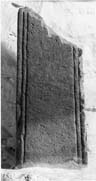
Object type: Part of plain cross-shaft [1]
Measurements: H. 62.3 cm (24.5 in); W. 29.2 > 26 cm (11.5 > 10.25 in); D. 20.3 > 19.7 cm (8 > 7.75 in)
Stone type: Coarse-grained, massive yellow sandstone
Plate numbers in printed volume: Pl. 54, 263-264
Corpus volume reference: Vol 1 p. 78
(There may be more views or larger images available for this item. Click on the thumbnail image to view.)
Present Location
Inside church porch
Evidence for Discovery
Probably found in 1879 restoration. Longstaffe (1880) noticed one fragment at northern springing of eastern gable of nave, which he compared with Hexham work, while (----) 1885-6c clearly mentions two fragments with vine scroll. Johnson (1895-6) says all stones found among steps of crow-stepped gables from 200-year old roof, his information coming from local man who superintended 1879 repairs.
Church Dedication
St John the Evangelist
Present Condition
Relatively unworn
Description
The faces are edged with double roll mouldings.
Discussion
This type of plain shaft is also found on other monastic sites, such as Jarrow (no. 7) and Whitby, Yorkshire. Its dimensions could be very similar to shaft 4, but the roll mouldings are different.
Date
Seventh to ninth century
References
Unpublished
Endnotes
1. The following are general references to the Escomb stones: Johnson 1895-6; (—) 1896-1905b, xxi.
