Select a site alphabetically from the choices shown in the box below. Alternatively, browse sculptural examples using the Forward/Back buttons.
Chapters for this volume, along with copies of original in-text images, are available here.


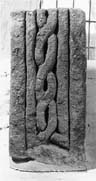
Object type: Upright pillar, part of church furnishing [1]
Measurements: H. 51.5 cm (20.5 in); W. 25.4 > 23.5 cm (9.75 > 9.25 in); D. 17.5 > 17 cm (6.75 > 6.5 in)
Stone type: Coarse-grained, massive yellow sandstone
Plate numbers in printed volume: Pl. 55.266-269
Corpus volume reference: Vol 1 p. 78
(There may be more views or larger images available for this item. Click on the thumbnail image to view.)
A (broad): A central panel contains a single twist framed in a fine inner roll moulding and broad outer flat-band moulding. The base moulding of the panel curves upwards.
B (narrow): The centre of the panel is deeply indented and edged by two roll mouldings.
C (broad): The centre of the panel is deeply indented and is framed by inner roll and outer flat-band mouldings.
D (narrow): Deeply grooved to form three central roll mouldings and two outer flat-band mouldings.
The indentation on B and C implies that this is the corner column of something into which two panels were slotted. It is possible that it is therefore the corner post of a shrine or altar (Thomas 1971, figs. 70, 88). The decorative grooving on D is found also on 2 and 7. The simple twist ornament also occurs on the sundial (no. 8), and on the `frith stool' at Hexham (no. 41).
