Select a site alphabetically from the choices shown in the box below. Alternatively, browse sculptural examples using the Forward/Back buttons.
Chapters for this volume, along with copies of original in-text images, are available here.


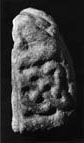
Object type: Incomplete house-shaped memorial
Measurements: L. 32.4 cm (12.75 in); W. 17.6 cm (6.9 in); D. 15.2 cm (6 in)
Stone type: Medium-grained, micaceous yellow sandstone
Plate numbers in printed volume: Pl. 166.889-895
Corpus volume reference: Vol 1 p. 172-173
(There may be more views or larger images available for this item. Click on the thumbnail image to view.)
This diminutive stone is incomplete on every face and appears to have been split at mid-point. One long face containing a bi-alphabetical inscription is perhaps complete save for the lower moulding, but examination of the face under the moulding seems to indicate that it could have been attached to a lower block.
Roughly half of one of the narrow sides survives. The long side is slightly curved and this, together with the remains of a pointed gable, gives the appearance of a house shape. The stone has an uncarved, slightly bombé, top which is possibly not its original form, since the point of the end gable projects above it and it seems plausible that the roof was originally higher (see below).
A (long): The base, and possibly the left edge of this face has a wide cable moulding. The face is divided vertically by a lumpy flat-band moulding, and at the top, roughly in the centre, the upper horizontal curves up and around, lying along the `roof' like a handle. This handle-like appearance is particularly convincing when seen from above. The surviving upright moulding on the left rises in an unbroken line to form the end ridge, whilst the horizontal top moulding appears to curve under the upright to form the base of the end gable. In the centre, the vertical moulding does not extend to the base of the stone, but terminates one line from the bottom in a rounded end. The mouldings have clearly been carved before the inscription, since the guide-lines for the inscription and, in one place, the lettering impinge on the central divider.
The inscription on the left panel is in Insular majuscules, and on the right panel in runes. Both are in Old English. The bottom line of the majuscules, however, crosses the entire face:
(a) Left panel: the first two lines are very worn, but the last three are clear. It may be read:
+ EO[—]
TAARE[FT]AER
HROETHBERHT[E]
BECUNAEFTAER
EOMÆGEBIDÆDDERSAUL[E]
(b) Right panel: the runic inscription is most worn also in the top line, but is in worse condition throughout. It may be read:
+ [—]
aeftaerroe[—]
tac[be]cunae[f]taere[o —]
geb[i ]daedÞe[r]saule
[1]Both inscriptions may be interpreted together: +Eo[—- ]ta aeftaer Hroethberht becun aeftaer eomae gebidaed Þer saute (Translation: 'in memory of Hroethberht, a monument of the uncle: pray for (sc. `his') soul'). Stephens (1884b, 136) saw additional letters on the 'roof' of the stone, but none are visible today.
D (narrow): This is divided into a panel of four-strand plain plait below a pointed gable with possibly a central support.
The scale of this piece sets it apart from the general run of house-shaped stone monuments. However, it is worth noting that some pre-Viking stones, such as at Ingleby Arncliffe and Dewsbury, Yorkshire, are smaller than the later hogback type. Although Collingwood (1927, 165) sees it as a diminutive hogback, it is not accepted into this category by Lang (1967), who has extensively studied this type of monument. Collingwood remarked perceptively if frivolously: `It looks as though a man called Uncle Robert must have grown up before he died, in which case the size of the stone has nothing to do with the size of the grave.' There is nothing in the report of the finding to indicate that this was found in a graveyard. Indeed, it seems to have been found in a field with building debris. The size invites comparison with the small shrines on the top of Irish crosses – or the house-shaped metal shrines which have survived in the British Isles and on the continent from the seventh and eighth centuries. The roof ridge on the Mortain casket rises to a point, and like Falstone carries a runic inscription, and there are other features which may be compared with the Gandersheim /Brunswick casket which bears an Anglo-Saxon runic inscription (the authenticity of which has been doubted) (Blouet 1956; (—) 1965a, 120, pl. 14; Page 1973, 36-7). The Brunswick casket has, like the Falstone stone, round ended hinges which are outlined by a raised moulding. The `handle' on the `roof' of the Falstone piece may be compared with the handle and clasp, and the `hinges' would be on the back. It seems to me that this piece is best thought of as a skeuomorph of a metal or bone reliquary or shrine. It could have stood on a small pediment, and it might, like some other inscriptions, have been built into the wall of a church.
