Select a site alphabetically from the choices shown in the box below. Alternatively, browse sculptural examples using the Forward/Back buttons.
Chapters for this volume, along with copies of original in-text images, are available here.


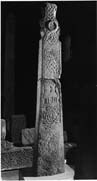
Object type: Cross-shaft and part of head, in two joining pieces [1]
Measurements: H. 231.1 cm (91 in); W. 43.2 > 26.7 cm (17 > 10.5 in); D. 17.8 > 14 cm (7 > 5.5 in)
Stone type: Coarse-grained, massive yellow gritstone with felspar
Plate numbers in printed volume: Pls. 57.278-279, 58.280-281
Corpus volume reference: Vol 1 p. 80
(There may be more views or larger images available for this item. Click on the thumbnail image to view.)
On all faces the shaft is plain below the carved panels. The cross-head is type B10 and is surrounded by a narrow roll-moulding on the broad faces. The horizontal arms are broken off. The vertical arms are carved on the broad faces only.
A (broad): Upper arm: six-strand plain plait; lower arm: bungled plait. In the centre is a boss with a sunken centre and four pierced holes, surrounded by a double roll moulding. The shaft is divided into three unequal panels by irregular punch-outlined grooved mouldings, which also edge it. (i) A pattern of muddled interlace with fine, rounded strands which develops into an eight-strand plain plait with wider median-incised strands. (ii) Two figures are crowded to the left; a space not big enough for another is unfilled on the right. Their haloes are joined; their square shoulders are in a continuous straight line. They have one arm in common; the other is possibly bent across their chests. Their belts join and penetrate their bodies. They wear knee-length tunics with straight triangular incised folds. Their feet are partly turned to the left, partly frontal. (iii) A lop-sided panel, the carving on which could have been intended to be a split plait motif, but which is actually formed from four pairs of ellipses linked by two concentric rings.
B (narrow): A panel of four-cord plait beginning with pattern E loops. A grooved moulding edges the shaft on either side of the panel.
C (broad): The upper arm of the cross is covered by a six-strand plain plait; the lower by a four-strand one with pointed terminals. In the centre of the head is a boss with sunken centre and four pierced holes, surrounded by a double roll-moulding. On the shaft the face is divided into two unequal panels by grooved mouldings, which also edge the shaft. (i) At the top is a quadruped with head turned back, and tongue and ear extended into interlace. Its feet are enmeshed in interlace. It stands above another quadruped facing in the opposite direction. Its long neck is bent back and its long ear extends into interlace, from which a single strand passes over its body and forms a single triquetra knot between its legs. (ii) A panel of eight-strand plain plait.
D (narrow): A very worn panel of indecipherable interlace. A grooved moulding edges the shaft on either side of the panel.
Despite the relatively large scale of this cross it is incompetently carved. The layout is lop-sided, the principles of interlace have been lost, and there is nothing of the competence of 7. Only the plain plait is competent and even that is irregular. The figures are carved in a shallow scratchy style and do not fill the frame. The most confident carving is of the animals on face A, but they are not as well drawn as on 2 (see Discussion under 2). The figures are paralleled on 3 and at Aycliffe (nos. 1, 4, 6 and 13).
