Select a site alphabetically from the choices shown in the box below. Alternatively, browse sculptural examples using the Forward/Back buttons.
Chapters for this volume, along with copies of original in-text images, are available here.


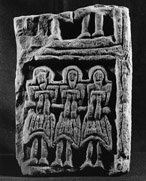
Object type: Part of cross-shaft [1]
Measurements: H. 40.7 cm (16 in); W. 28 cm (11 in); D. 15.3 cm (6 in)
Stone type: Medium-/fine-grained yellow/orange sandstone
Plate numbers in printed volume: Pl. 61.286-289
Corpus volume reference: Vol 1 p. 81
(There may be more views or larger images available for this item. Click on the thumbnail image to view.)
The shaft is edged by a double flat-band moulding with an incised median line, which returns as a horizontal moulding with two irregular incised lines, to form two panels.
A (broad): (i) The calf-length hem-lines and lower legs of two figures. Their feet are carved so as to appear frontal. (ii) Three frontal figures holding books in their upturned hands. Their haloes and tunic hems and belts form a continuous line. Their faces are wedge-shaped with lightly incised round eyes and straight mouths. Their tunics are double-outlined with vertical slashed folds.
B (narrow): Only a fragment of plain plait with median-incised strands survives. There is a grooved moulding visible on the surviving edge.
C (broad): Possibly reshaped. There is a staff, possibly a cross, with double incisions in the centre. A flat-band moulding with an incised median line is visible on the surviving edge.
D (narrow): Broken.
The pattern of figures holding books set in panels of twins and triplets is most closely paralleled on Aycliffe 3. However, this cross shares certain features with Gainford 1, namely similar stone, the figures, and the plain plait on the surviving narrow face. It seems that either Aycliffe or Gainford copied the Auckland St Andrew cross in an Anglo-Scandinavian style, and that both Aycliffe and Gainford shared common traditions.
