Select a site alphabetically from the choices shown in the box below. Alternatively, browse sculptural examples using the Forward/Back buttons.
Chapters for this volume, along with copies of original in-text images, are available here.


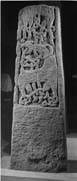
Object type: Part of cross-shaft [1]
Measurements: H. 124.5 cm (49 in); W. 40.6 > 30.5 cm (16 > 12 in); D. 17.8 > 12.6 cm (7 > 5 in)
Stone type: Medium-/coarse-grained, massive yellow sandstone
Plate numbers in printed volume: Pls. 59. 282-283, 60.284-285
Corpus volume reference: Vol 1 p. 80-81
(There may be more views or larger images available for this item. Click on the thumbnail image to view.)
The shaft is plain below the single panel on all faces.
A (broad): The panel is framed in a flat-band moulding. At the top is the body of a quadruped, which is double-outlined with spiral hip joints at the front and back, and a hooked foot. Its four feet are enmeshed in interlace which falls in a strand over its body and joins with the tongue and ear extensions of the animal below, which is placed in an opposed position. This beast has a double-outlined body and a canine head. Its front foot divides into interlace, the other feet being hooked.
B (narrow): A short panel of changing interlace, in which a variety of pattern A becomes simple pattern F; this changes into pattern D loops, which develop into six-strand plain plaits. A flat-band moulding edges the shaft on either side of this panel.
C (broad): At the top a coiled ribbon-animal whose tongue and tail extensions develop into a ten-strand plain plait with median-incised strands. The body of the animal is double-incised and it has a rounded head. A flat-band moulding edges the shaft on either side of this panel.
D (narrow): Two and a half registers of simple pattern F with pointed terminals and median-incised strands. A flat-band moulding edges the shaft on either side of this panel.
This is a more competent carving than shaft 1. The carver shows an understanding of interlace principles and the ability to carry them through. The great beasts are more monumental than on 1. Their hooked feet and spiral hip joints, as well as the total composition, relate them to carvings in the Danelaw such as St Alkmund's in Derby, and Folkton and Nunburnholme, both in Yorkshire (Lang 1978b, 149). Here also there are large quadrupeds and reptiles which derive from ninth-century Mercian traditions. This carver seems more at home with the interlace than the animal motifs, but it is interesting that Gainford consistently reflects styles which are more popular farther south.
