Select a site alphabetically from the choices shown in the box below. Alternatively, browse sculptural examples using the Forward/Back buttons.
Chapters for this volume, along with copies of original in-text images, are available here.


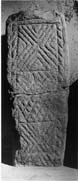
Object type: Cross-shaft [1]
Measurements: H. 102 cm (40.25 in); W. (at top tapering to bottom -broken) 37 cm (14.25 in); D. 19 cm (7.5 in)
Stone type: Coarse-/very coarse-grained, massive yellow sandstone
Plate numbers in printed volume: Pl. 66.318
Corpus volume reference: Vol 1 p. 84
(There may be more views or larger images available for this item. Click on the thumbnail image to view.)
Only one visible face is carved.
A (broad): The shaft is edged by a double cable moulding and horizontally across the top by a thin roll moulding; the face is divided into three panels by two horizontal grooves. (i) and (iii) A design of interlocking triangles. (ii) A criss-cross pattern, composed of tiny raised diamonds.
B and D (narrow): Uncarvcd.
C (broad): Not visible.
Such geometric patterns incised or in low relief seem to be an eleventh-century feature (Kendrick 1949, pl. 45, 3; see also Corbridge 5 and Bolam 2 and 3).
