Select a site alphabetically from the choices shown in the box below. Alternatively, browse sculptural examples using the Forward/Back buttons.
Chapters for this volume, along with copies of original in-text images, are available here.


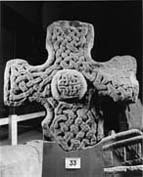
Object type: Cross-head and part of shaft [1]
Measurements: H. 70.5 cm (27.75 in); W. 68 cm (26.75 in); D. 15.2 cm (6 in)
Stone type: Fine-grained, bedded creamy sandstone
Plate numbers in printed volume: Pls. 66.319, 67.324-326
Corpus volume reference: Vol 1 p. 84-85
(There may be more views or larger images available for this item. Click on the thumbnail image to view.)
Head, type A11/C11. Broad faces enclosed by a roll moulding.
A (broad): Top arm: eight-strand plain plait; lower arm: eight-strand plain plait; right arm: mutilated; left arm: half pattern F, all with median-incised strands. In the centre is a raised and chamfered boss with four inset linked triquetras.
B (narrow): End of horizontal arm: a four-strand plain plait.
C (broad): Top and horizontal arms: eight-strand plain plait, rather irregularly executed with median-incised strands, surrounding a raised central boss with recessed petal design; lower arm: confused interlace, with median-incised strands, framed by a grooved moulding.
D (narrow): End of horizontal arm: bungled closed circuit pattern D.
This type of head is like 3 and 14 in the stone and treatment of the central roundels. Its stone type does not seem to fit any of the surviving shafts.
