Select a site alphabetically from the choices shown in the box below. Alternatively, browse sculptural examples using the Forward/Back buttons.
Chapters for this volume, along with copies of original in-text images, are available here.


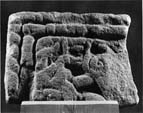
Object type: Fragment of grave-cover [1]
Measurements: L. 21.5 cm (8.5 in); W. 30.5 cm (12 in); D. 12.2 cm (4.75 in)
Stone type: Coarse-grained, massive yellow sandstone
Plate numbers in printed volume: Pl. 69.343-346
Corpus volume reference: Vol 1 p. 86-87
(There may be more views or larger images available for this item. Click on the thumbnail image to view.)
All faces but one destroyed.
A (top): Framed in an outer cable moulding and an inner roll moulding is an animal. Its head is bent back over its double-outlined body which has a spiral hip. It has a round ear, bumpy forehead, and pointed oval eye. Its tongue extends into interlace, and another extension crosses its neck.
This grave-cover is very similar to those found in the York minster excavations (Pattison 1973, pl. 39B). The animal with its rounded head and scroll-like ear is very similar to ninth-century Mercian beasts, but has further developed characteristics such as the interlaced body and the fang. As a type it is closely related to Gainford 2. Lang (1978b, 151-3) discusses the dating of this type of monument in some detail.
