Select a site alphabetically from the choices shown in the box below. Alternatively, browse sculptural examples using the Forward/Back buttons.
Chapters for this volume, along with copies of original in-text images, are available here.


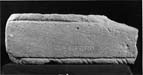
Object type: Part of grave-cover [1]
Measurements: L. 68.6 cm (26.75 in); W. 26.7 cm (10.5 in); D. 10.2 cm (4 in)
Stone type: Coarse-grained, massive yellow sandstone
Plate numbers in printed volume: Pls. 69.347-348, 70.349-352
Corpus volume reference: Vol 1 p. 87
(There may be more views or larger images available for this item. Click on the thumbnail image to view.)
A (top): A plain dressed surface is enclosed by roll and cable mouldings, with widely spaced cable groupings.
B (long): Framed at the top by a bold roll moulding with widely spaced cabling is the upper part of an Old English inscription in Anglo-Saxon capitals:
[A]L[RI]H[CSE]T[AE –
Translation: 'Alrihc set up . . .'
C (end): Broken.
D (long): A bold roll moulding at the top with traces of widely spaced cabling. Below, a narrow flat-band moulding and a roll moulding with continuous cabling, both probably secondary.
E (end): Roughly dressed.
F (bottom): A continuous cable moulding runs along one edge. The other edge has later been crudely rebated and the intervening surface roughly dressed back.
Inscriptions which run round the edges of objects are not unknown in other media in the Anglo-Saxon period (Okasha 1971, pls. 4, 140). However, it is very rare to find an inscription in stone on the vertical face of what seems to be a recumbent monument. Falstone 2 is only a remote parallel. The letters are fairly crudely tooled but are clearly part of the Anglian tradition of formulae. The name of the person who set up the cover is not incontrovertibly identifiable with any Old English form. The -rihc seems to be a variant of -ric, but the prefix could be reconstructed in several ways (Okasha 1971, 72). This could be one of the earliest pieces from the site, but its form and the lack of ornament make it possible that it is a very late piece of the eleventh century (like 23).
