Select a site alphabetically from the choices shown in the box below. Alternatively, browse sculptural examples using the Forward/Back buttons.
Chapters for this volume, along with copies of original in-text images, are available here.


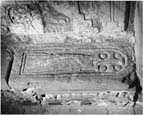
Object type: Grave-cover [1]
Measurements: L. 113 cm (46.5 in); W. 45.5 cm (17.9 in); D. 13 cm (5.1 in)
Stone type: Coarse-grained, massive yellow sandstone
Plate numbers in printed volume: Pl. 74.361
Corpus volume reference: Vol 1 p. 88
(There may be more views or larger images available for this item. Click on the thumbnail image to view.)
Only one carved face is visible.
A (top): Outlined with a round-headed roll moulding is a tapering shaft edged by a roll moulding and surmounted by a cross, type B10, in low relief. The shape of the head has been outlined leaving ball-like projections on the arms.
Such grave-covers are difficult to date. The type of rather thick round-headed slab is found at Escomb (no. 7), but the form of the cross and the larger scale of this piece could make it later.
