Select a site alphabetically from the choices shown in the box below. Alternatively, browse sculptural examples using the Forward/Back buttons.
Chapters for this volume, along with copies of original in-text images, are available here.


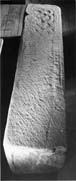
Object type: Grave-cover or seat [1]
Measurements: L. 146 cm (57.5 in); W. 35.6 > 33 cm (14 > 13 in); D. 37 cm (14.5 in)
Stone type: Coarse-grained, massive yellow sandstone
Plate numbers in printed volume: Pls. 72.356, 72.358, 73.359-360
Corpus volume reference: Vol 1 p. 88
(There may be more views or larger images available for this item. Click on the thumbnail image to view.)
A (top): Most of the ornament is worn or dressed away but it seems to consist of a four-strand plain plait enclosed in a wide flat frame containing a band of step pattern 1.
B (long): An arcade decoration joining six arches. The background is smoothly dressed and the arches and the plinth-like moulding on which they stand are deeply carved.
C (end): The arcade design is continued and forms a double arch.
D (long): Uncarved.
E (end): An incised cross, type B8.
This massive piece was obviously carved to be set against a wall. For this reason it could be an elaborately carved seat. However, the ornament on the top and the fact that other forms of monument occur which are clearly set against walls render this more probably a funerary monument. Intersecting arcades are found in late eleventh-century work, such as Hexham 45. Incised crosses of this shape are also found at Corbridge (no. 5) and here (no. 32). The plain plait is competently rendered and this seems to be a monument of the pre-Conquest church.
