Select a site alphabetically from the choices shown in the box below. Alternatively, browse sculptural examples using the Forward/Back buttons.
Chapters for this volume, along with copies of original in-text images, are available here.


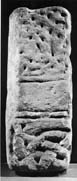
Object type: Incomplete cross-shaft
Measurements: H. 61.5 cm (24.5 in); W. (max.) 23.5 cm (9.25 in); D. 17.8 cm (7 in)
Stone type: Fine-grained, bedded grey sandstone
Plate numbers in printed volume: Pl. 164.871-874
Corpus volume reference: Vol 1 p. 173-174
(There may be more views or larger images available for this item. Click on the thumbnail image to view.)
A (broad): No edge moulding survives and a section of the right side is now broken away. The face is divided by horizontal roll mouldings with a wide plain panel between them. (i) A panel of interlace which is nearly worn away save for the hole patterns (Haverfield and Greenwell 1899, 51; Adcock 1974, 280). It is either a ten- or twelve-cord pattern, but seems to have irregularities in the strand widths and crossing points. (ii) Plain. (iii) Wide punch-outlined strands seem to form a ribbon animal composition.
B and D (narrow): Broken away.
C (broad): No edge mouldings survive. The face is subdivided by a plain panel with horizontal roll mouldings. (i) The central portion of a plait which seems to be double-stranded simple pattern E. (ii) Plain. (iii) A ribbon animal composition.
Despite the worn condition of this piece, it was clearly an interesting monument fitting into the Bernician group which favoured interlace and ribbon animals. Adcock (1974, 279-80) makes a comparison between the upper panel of face A and Tynemouth 1. These panels are, however, so worn that it is impossible to be precise.
Double-stranded simple pattern E which appears in an elegant double-stranded form on Bewcastle also appears at Lindisfarne (Allen 1903, fig. 449A), and ribbon animals of this type are found at Abercorn, Bywell 1 and Coldingham (ibid., figs. 439A, 449B) and on Bamburgh 1. Ribbon animals of a rather different sort can be found on Lindisfarne 1, 2 and 6, and Bywell 1 (Introduction, p. 19). Blank panels edged by horizontal mouldings are also found on Lindisfarne crosses. On the whole this piece seems to be a development from the eighth-century Insular ornament of Aberlady and Abercorn and belongs with the later developments of Lindisfarne and the associated mainland.
