Select a site alphabetically from the choices shown in the box below. Alternatively, browse sculptural examples using the Forward/Back buttons.
Chapters for this volume, along with copies of original in-text images, are available here.


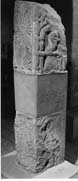
Object type: Part of cross-shaft, in two pieces [1]
Measurements:
Total height as reconstructed: 100.5 cm (39.6 in)
a, lower piece: H. 31 cm (12 in); W. (incomplete) 18.5 cm (7.5 in); D. 20.4 cm (8 in)
b, upper piece: H. 39.3 cm (15.5 in); W. 23.5 cm (9.25 in) D. 19.5
Stone type: Coarse-grained, massive, micaceous yellow sandstone
Plate numbers in printed volume: Pls. 76.382-384, 77.385-386
Corpus volume reference: Vol 1 p. 91-92
(There may be more views or larger images available for this item. Click on the thumbnail image to view.)
The faces are edged with baluster ornament, although this only survives in detail on one side.
A (broad): Only the top section survives clearly. At the top left is a triquetra knot attached to an arch. Its block capitals join the capital/base of a baluster. Beneath the arch is a profile figure facing right. He has a smooth rounded head, prominent nose and chin, and sunken eye. His right hand grips a long object which has been identified as a sword (Haverfield and Greenwell 1899, 91) with a rounded pommel and grooved blade. The figure is dressed in a belted tunic. Below are possible traces of another triquetra and arch.
B (narrow): A panel of pattern A units turned in different directions; the upper section, however, is a muddle with strands dividing into two. The strands are well modelled and deeply cut.
C (broad): Dressed back.
D (narrow): This is the most complete surviving face and is carved with a key pattern (Allen 1903, no. 1000).
There are several features of this shaft which link it with Chester-le-Street and Lindisfarne. The proportions of the stone and the lack of understanding of interlace principles combined with an ability to carve deeply modelled strands have been compared with Chester-le-Street l (Adcock 1974, 315-16). The beaked profile of the man is also comparable with the figures on the cross-socket from Chester-le-Street (no. 12) and with Lindisfarne no. 37. The key patterning also derives from an Insular tradition and is closely paralleled at Lindisfarne (nos. 5-b) and Alnmouth. However, the depiction of secular figures holding weapons is most closely paralleled in the Anglo-Scandinavian tradition, and it is possible that there is some link with Sockburn where shaft no. 8 is similarly edged with baluster ornament. Adcock's linking of this stone with late stones at Jarrow (no. 4) and with Chester-le-Street 1 seems convincing. It is possible that the inspiration for the balusters came from Jarrow and was taken over from that source here and at Sockburn.
