Select a site alphabetically from the choices shown in the box below. Alternatively, browse sculptural examples using the Forward/Back buttons.
Chapters for this volume, along with copies of original in-text images, are available here.


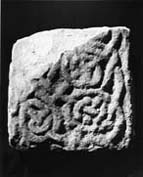
Object type: Part of cross-shaft [1]
Measurements: H. 34.2 cm (13.5 in); W. 31.8 cm (12.5 in); D. 28.5 cm (11.25 in)
Stone type: Coarse-grained, massive yellow sandstone
Plate numbers in printed volume: Pl. 77.387-390
Corpus volume reference: Vol 1 p. 92
(There may be more views or larger images available for this item. Click on the thumbnail image to view.)
Part of a single roll moulding survives on A, B and C.
A (broad): The interlace pattern is lop-sidedly arranged and mixed in type. On the left complete pattern A knots, on the right closed circuit and spiralled pattern A.
B (narrow): Simple pattern E.
C (broad): Two complex and muddled patterns which fill the face are joined in the centre by four strands. A blank space on either side divides the two blocks of pattern.
D (narrow): Dressed back for reuse.
The attempt to continue complicated changing patterns, linked by central strands, is found in other centres where mid ninth-century traditions merged with tenth-century ones (Introduction p. 17). Widely spaced pattern E is found at centres which maintained Insular traditions, such as Hart (nos. 2 and 4), Billingham (no. 4), Chester-le-Street (nos. 4 and 6) and Aycliffe (no. 2). The spiralled or closed circuit pattern A is again found at Sockburn (no. 8) and Chester-le-Street (nos. 2 and 7), and at Norton (no. 1) with the same irregularity. Spiralled pattern A is popular in Lindisfarne (nos. 3 and 6) and at Alnmouth and over much of Bernicia. On the other hand, turned patterns are more common in the later traditions: Chester-le-Street 5, Alnmouth, Woodhorn 1 and Aspatria (Collingwood 1927, fig. 178). The irregularities of the interlaces on this shaft show a deterioration in the tradition.
