Select a site alphabetically from the choices shown in the box below. Alternatively, browse sculptural examples using the Forward/Back buttons.
Chapters for this volume, along with copies of original in-text images, are available here.


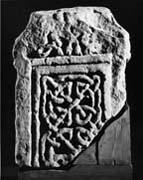
Object type: Cross-shaft and part of cross-head [1]
Measurements: H. 37.1 cm (14.6 in); W. 26 cm (10.25 in); D. 14 cm (5.5 in)
Stone type: Medium-grained, massive pale yellow sandstone
Plate numbers in printed volume: Pl. 173.918-921
Corpus volume reference: Vol 1 p. 178
(There may be more views or larger images available for this item. Click on the thumbnail image to view.)
Head, type A9.
A (broad): The base of the head is very damaged but seems to contain two confronted animals whose front legs are crossed. The one on the left seems to have a long looped tail. Below, the shaft is edged with a wide flat-band moulding, and an inner roll moulding encloses one and one half registers of pattern C with outside strands.
B (narrow): Below the arm moulding is a bar terminal, a pattern D loop, and the start of a four-strand plain plait.
C (broad): The cross-head is edged with a wide flat-band moulding and is filled with irregular plait-work with V-bends. Below, two panels are contained in inner roll mouldings (i) A simple four-strand plain plait. (ii) contains a curved feature with double incised outlines. This could be a coiled ribbon animal or it could be the top of an arch as shown by Collingwood (1925, fig. 15).
D (narrow): The inner curve of the cross-arm is plain but the ends of the arm are enriched by a bold triple moulding. Below, a panel of four-strand plain plait with a pattern D loop and bar terminal is contained within a wide flat-band moulding.
The dressing of the stone is competent and the cutting of the interlace is in a good, confidently chiselled, technique. There is an understanding of the simple interlace patterns which were popular with the Lindisfarne/Durham school. The use of side panels of plait-work inset between wide flat borders is found on late work at Lindisfarne, as are the two confronted animals, seated in the cross-head of Lindisfarne 2. The pattern on face A is also found at Durham and at Alnmouth (Introduction, p. 18).
