Select a site alphabetically from the choices shown in the box below. Alternatively, browse sculptural examples using the Forward/Back buttons.
Chapters for this volume, along with copies of original in-text images, are available here.


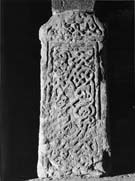
Object type: Cross-shaft and part of cross-head [1]
Measurements: H. 78.2 cm (30.75 in); W. 35.5 > 30.3 cm (14 > 12 in); D. 14 cm (5.5 in)
Stone type: Medium-grained, massive yellow sandstone
Plate numbers in printed volume: Pl. 177.937-939
Corpus volume reference: Vol 1 p. 178-179
(There may be more views or larger images available for this item. Click on the thumbnail image to view.)
Head, possibly type A9.
A (broad): The head is outlined by a flat-band moulding, which encloses irregular interlace and what could be an extended animal. Below, the surviving section of the shaft is edged by a flat-band moulding with an inner roll moulding, and the face is covered by an irregular and confused interlace, which finishes with a bar terminal and does seem to include in the third unit on the right a reptilian head with a round eye.
B (narrow): [2] Collingwood's drawing shows four and a half registers of closed circuit turned pattern D with a bar terminal. The base of the lower cross-arm has a small panel containing one register of closed circuit half pattern F with bar terminals.
C (broad): Built in.
D (narrow): Collingwood has five registers of closed circuit turned pattern D with a bar terminal. If his depiction of the base of the lower cross-arm is accurate, it had a panel containing a bungled version of the interlace in the corresponding panel of B.
Collingwood's drawing of face A (1925, fig. 16) is not entirely accurate. The animal in interlace which he saw on the cross-head is not clearly decipherable, nor does there seem to be a complete animal in the interlace – only a reptilian head. The combination of animals and interlace represents a different tradition from the earlier Hexham pieces, and seems, like no. 7, to be a product of the old Lindisfarne traditions as practised by the community of St Cuthbert (Introduction, p. 32; Cramp 1974, 137).
1. The following are general references to the Hexham stones: (—) 1855-7a, 45-6; Rowe 1877, 62-3; Allen 1889, 230; Bailey 1980, 79, 81, 83.
2. None of the ornament on the narrow sides is now easily visible but Collingwood's drawing was checked by Adcock (1974, 350 - 1).
