Select a site alphabetically from the choices shown in the box below. Alternatively, browse sculptural examples using the Forward/Back buttons.
Chapters for this volume, along with copies of original in-text images, are available here.


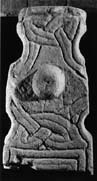
Object type: Part of cross-head and part of top of shaft [1]
Measurements: H. 58.4 cm (23 in); W. 30.8 cm (12 in); D. 16.5 cm (6.5 in)
Stone type: Coarse-grained, massive pale yellow sandstone
Plate numbers in printed volume: Pl. 178.948-951
Corpus volume reference: Vol 1 p. 180-181
(There may be more views or larger images available for this item. Click on the thumbnail image to view.)
Head, type C11.
A (broad): A crude roll moulding surrounds the head and encloses two strands with a median line which form a Stafford Knot (simple pattern E) in each arm. In the centre is a prominent boss with a hole in the centre, which may have been used for shaping the boss. Below, a rough double roll moulding begins the frame for a panel.
B (narrow): Arm missing. At the top of the shaft a flat-band moulding encloses the terminal of a median-incised interlace pattern, again a Stafford Knot.
C (broad): A crude roll moulding surrounds two strands which cross and are inorganically attached to three twists above and below. In the centre is an ill-shaped and mutilated boss. Below, a single roll moulding surrounds a plain panel which bears some slight marks, but not formed enough to be an inscription.
D (narrow): Arm missing. There are traces that the side of the shaft had interlace, now very worn, but the remains suggest that a Stafford Knot (simple pattern E) was again used as a terminal. There are traces of a roll moulding edging the shaft.
This head is of markedly cruder workmanship than crosses 6 and 7. The flat median-incised strands are in a grooved technique and the principles of forming interlace are lost. In technique this is nearest to 7.
