Select a site alphabetically from the choices shown in the box below. Alternatively, browse sculptural examples using the Forward/Back buttons.
Chapters for this volume, along with copies of original in-text images, are available here.


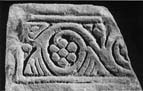
Object type: Cross-base [1]
Measurements: H. 30.7 cm (12 in); W. 30.7 cm (12 in); D. 15.2 cm (6 in)
Stone type: Medium-grained, massive orange/yellow sandstone
Plate numbers in printed volume: Pl. 176.928-932
Corpus volume reference: Vol 1 p. 181
(There may be more views or larger images available for this item. Click on the thumbnail image to view.)
Ornament survives on two side faces and the top of the base and is framed with a double roll moulding.
A: The roll mouldings enclose a horizontal simple scroll of which one complete and one incomplete volute survive. It ends with two leaves, the upper a small triangular leaf with a double outline, and the lower a small veined split leaf. The volute encloses a rosette berry bunch, and the spaces between the volutes are filled by a veined split leaf attached to the volute, and a bud which springs from the plain node.
B and C: Missing.
D: The roll mouldings enclose a terminal of two crossing strands which curl into a heart shape.
E (top): A panel of interlace, alternating half pattern C with outside strands and missed crossings, is enclosed within a fine roll moulding and there secms to be a central blank panel.
This base is seen by Collingwood (1925, 813, fig. 12) as the base for 4, but, as I have pointed out elsewhere (Cramp 1974, 132-3), the only linking motif is the form of the berry bunch which is also found on 3. Nevertheless the style of cutting, by outlining with a punch rather than carving with a chisel, links 12 and 4. They should be seen as of the same date if not as part of the same monument. The leaves on this piece are very unusual in Hexham work and indeed in northern sculpture as a whole. The split leaf can be paralleled, however, on the tree-scroll from Northallerton, Yorkshire (Cramp 1974, pl. 22A). The triangular leaf with double-outlined centre is more typical of Wessex and the midlands, although such triangular leaves are found on a ninth-century shaft at Ilkley, Yorkshire.
