Volume I: County Durham and Northumberland
Select a site alphabetically from the choices shown in the box below. Alternatively, browse sculptural examples using the Forward/Back buttons.
Chapters for this volume, along with copies of original in-text images, are available here.
Current Display: Hexham 20, Northumberland


Overview
Object type: Fragment of animal frieze(?) or step(?) [1]
Measurements: H. 19 cm (7.5 in); W. 23.5 cm (9.25 in); D. 11.5 cm (4.5 in)
Stone type: Medium-grained, massive pale yellow sandstone
Plate numbers in printed volume: Pl. 179.956-957
Corpus volume reference: Vol 1 p. 184-185
(There may be more views or larger images available for this item. Click on the thumbnail image to view.)
Present Location
South aisle of choir of abbey
Evidence for Discovery
None. First noticed by R. Cramp in 1972
Church Dedication
St Andrew
Present Condition
Damaged but unworn
Description
Only one face is carved.
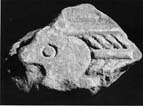
A (long): The head and part of the body of a fish with a broad slightly chamfered upper border. The jaws of the fish are gaping, the eye rounded. Its body is conveyed by a herring-bone effect on either side of a broad central rib. The surface is covered by a white undercoat, presumably for paint.
Discussion
The deep cutting and the smooth dressing of the surface, even the treatment of the eye, is closely similar to 33 and 34. The herring-bone ornament is paralleled on imposts 26 and 28. It seems evident that these pieces belong to the same tradition of carving if not the same scheme (Introduction, p. 19). The fish with its carp-like head and rounded gaping jaws is quite unlike all the reptilian creatures of Style II and its derivatives, as for example on the jambs of the porch at Monkwearmouth (no. 8). At the hypogeum at Poitiers fish-like creatures are found on steps, and this could be a similar architectural feature (Introduction, p. 25; Hubert, Porcher and Volbach 1969, pls. 68, 70).
Date
Last quarter of seventh century
References
Cramp 1974, 120, 175, pl. 10C
Endnotes
1. The following are general references to the Hexham stones: (—) 1855-7a, 45-6; Rowe 1877, 62-3; Allen 1889, 230; Bailey 1980, 79, 81, 83.