Select a site alphabetically from the choices shown in the box below. Alternatively, browse sculptural examples using the Forward/Back buttons.
Chapters for this volume, along with copies of original in-text images, are available here.


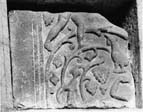
Object type: Three fragments of panels, probably part of single composition [1]
Measurements: Fragment a: H. 30.5 cm (12 in); W. 40.6 cm (16 in); D. 16.5 cm (6.5 in); Fragment b: H. 34 cm (13.75 in); W. 30 cm (11.75 in); D. 21 cm (8.25 in); Fragment c: H. 52.2 cm (20.75 in); W. 18 cm (7 in); D. 16 cm (6.25 in).
Stone type: a and b, coarse-grained, massive yellow sandstone; c, medium-/coarse-grained massive yellow sandstone.
Plate numbers in printed volume: Pls. 179.961-962; 180.963-968
Corpus volume reference: Vol 1 p. 185-186
(There may be more views or larger images available for this item. Click on the thumbnail image to view.)
Fragment a.
A (broad): Edged with a flat outer frame and a fine double inner roll moulding. At the top are the striding naked legs of a putto with the left arm of a similar figure at the bottom right reaching up to pick a berry bunch. Immediately above this arm is a cock, and at the bottom left the horned head of a goat which reaches up to bite a leaf. The vine stems sprout short curling tendrils, large triangular berry bunches and small triangular vine-like leaves. B and E: Broken. C, D and F: Not visible.
Fragment b.
A (broad): Edged by a wide flat frame. Within, a naked putto in a nearly frontal pose, with his feet braced, apparently in the act of drawing a bow. The bow merges with the strands of a scroll which passes behind his back. Between his feet is a small curling tendril. B, C, D and F: Broken. E: Smoothly dressed.
Fragment c.
A (broad): A corner edged with a double roll moulding and broken along both edges. Part of the strands of a sprawling scroll with short curling tendrils survives. They are very closely massed together, but there is no sign of the ridged node shown in Collingwood's reconstruction drawing. B, C and F: Broken. D: Broken; possible traces of a roughly dressed surface survive in the lower right corner. E: Roughly dressed.
The first attempt to form these pieces into a single composition was made by Collingwood (1925, fig. 2). However, there are some difficulties in doing this (Cramp 1974, 124-5), notably the greater depth of fragment b and the difference in their frame types. Fragment c is clearly a left corner of a panel, and could before it was broken have had a similar frame to a. There is little evidence as to how b fits in relation to the others. It is obviously also a left-hand piece. The type of figure carving is the same as on a, as are the vine strands and tendrils which, like a, pass behind the figure. It is possible that it belongs to the same composition, but that this is, as Collingwood draws it, a tall panel, c. 4.5 ft high, is impossible to prove. It is true that 19 seems to have been a panel of similar proportions; perhaps a-c were part of such a composition. However, they might have formed two or more panels of a different shape from Collingwood's reconstruction. Moreover, do these pieces belong to the Anglo-Saxon or Roman series? The type of sprawling vine is found in many Roman contexts, in particular at Corbridge, and scenes with putti picking grapes or animals eating grapes are commonplace in Roman art (Dorigo 1971, fig. 11, 21) Where the inhabited scroll is found in Anglo-Saxon art, it is normally confined within the narrow frame of a cross, and, although there are archers or hunters in Northumbrian sculpture (Jarrow 20 and Auckland St Andrew 1), they do not occur in the same panel. The only Anglo-Saxon carved figure shown naked is from Breedon (Cramp 1977, 198, fig. 51a), where it is again derived from a Classical hunting scene. This together with the scroll treatment puts the Hexham piece in a sub-Classical rather than an English context. Moreover the inhabited scroll seems to have been a motif more popularized by the Wearmouth/Jarrow school than by Hexham (Introduction, p. 16). In short, unless this is a carving by a foreign carver, then it should be Roman. Nevertheless it could have been reused and thus an influential source in the Saxon period.
