Select a site alphabetically from the choices shown in the box below. Alternatively, browse sculptural examples using the Forward/Back buttons.
Chapters for this volume, along with copies of original in-text images, are available here.


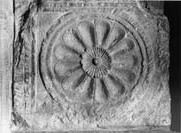
Object type: Panel [1]
Measurements: H. 53.5 cm (21 in); W. 63.8 cm (25.1 in); D. Built in
Stone type: Medium-/fine-grained, massive pale yellow sandstone
Plate numbers in printed volume: Pl. 182.972
Corpus volume reference: Vol 1 p. 186
(There may be more views or larger images available for this item. Click on the thumbnail image to view.)
Only one face is visible.
A (broad): Surrounded by a triple moulding: the innermost is a fine roll moulding, the outer ones, which become increasingly wider, being chiselled flat. The mouldings are almost obliterated at the top and on the right side. Filling the panel is a compass-drawn rosette. The centre is built up around a grooved boss surrounded by closely packed veined petals. The thirteen outer petals are deeply scooped and divided by incised lines.
There is some doubt as to whether this piece is Roman or like 21 a piece of very competent foreign carving. If Roman, it is uncertain as to what its function is. Such square panels with rosettes are found on the facades of buildings such as Poitiers baptistery, south front (Hubert, Porcher and Volbach 1969, pl. 48). The unworn condition of this, however, makes it unlikely that it was once outside. It seems more likely to have been part of a chancel or choir enclosure. The rosette motif is found in the centre of cross-heads at Hexham (no. 8) and Carlisle (Collingwood 1927, fig. 72), but not with the elegant built-up centre. Nevertheless, like 21, if it is to be considered as a Roman survival (Phillips 1977, 55-6), it may have been reused and served as a model for later work.
