Select a site alphabetically from the choices shown in the box below. Alternatively, browse sculptural examples using the Forward/Back buttons.
Chapters for this volume, along with copies of original in-text images, are available here.


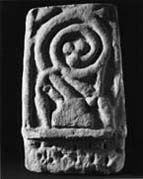
Object type: Lower part of cross-shaft
Measurements: H. 38 cm (15 in); W. 21.5 > 20.5 cm (8.75 > 8 in); D. 15.5 > 15 cm (6.25 > 6 in)
Stone type: Greyish yellow sandstone
Plate numbers in printed volume: Pl. 188.1035-1038
Corpus volume reference: Vol 1 p. 193-194
(There may be more views or larger images available for this item. Click on the thumbnail image to view.)
The base is tapered and below the lowest moulding is rough dressed. The shaft is edged by a single roll moulding. The base is edged by a horizontal flat band moulding. Faint traces of base for paint.
A (broad): One volute of a spiral plant-scroll which springs from a stepped base. The volute terminates in a pair of triangular leaves with a round bud, and from the scroll on the left two large plain pointed leaves fall. On the right is a pair of long pointed leaves with a rounded bud. On the top right is a single bud which marks the division from the next volute. On the top left is the tip of a leaf.
B (narrow): A panel of interlace: the terminal unit is half pattern F with outside strands, but the unit above is a wide element crossed by two diagonals.
C (broad): Half pattern F, with outside strands, terminating in a pair of pattern E or A loops. The pattern F elements are pushed together so that they make closed circuit figure-of-eight loops.
D (narrow): Part of a panel of interlace. Not enough survives for the pattern to be decipherable.
The cutting of this piece is deep and confident. The interlace is closely paralleled by Norham 14. Similarly the compositions of leaves and buds are also like Norham 1, although the scrolls at Norham are more complex and tangled. This seems, however, to belong happily with the Bernician scrolls of the ninth century. It is small-scale work, but competent.
