Select a site alphabetically from the choices shown in the box below. Alternatively, browse sculptural examples using the Forward/Back buttons.
Chapters for this volume, along with copies of original in-text images, are available here.


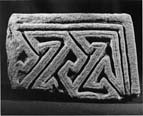
Object type: Part of cross-base
Measurements: H. 25.4 cm (10 in); W. 38.1 cm (15 in); D. 16.5 cm (6.5 in); D. of socket: 10.9 cm (4.25 in)
Stone type: Coarse-grained, massive yellow sandstone
Plate numbers in printed volume: Pl. 89.467-470
Corpus volume reference: Vol 1 p. 105
(There may be more views or larger images available for this item. Click on the thumbnail image to view.)
Edged with an outer flat-band and inner roll moulding.
?A (broad): Deeply cut key pattern (Allen 1903, no. 941) with median-incised strands.
?B (narrow): Part of one register of median-incised plait, complete turned pattern A with cross-joined terminals.
?C (broad) and ?D (narrow): Broken off.
Not enough bases survive to provide good comparative evidence. This is the only one in this area with a key pattern, although the distribution of key patterns is somewhat sparse (Introduction, p. 19). The pattern seems to have had the greatest popularity, however, in the ninth century. This date would also be supported by the use of median-incised widely spaced plaits. The carving is crisp and confident.
