Select a site alphabetically from the choices shown in the box below. Alternatively, browse sculptural examples using the Forward/Back buttons.
Chapters for this volume, along with copies of original in-text images, are available here.


Object type: Grave-cover(?) or cross-base(?), in three joining pieces
Measurements: L. 91.4 cm (31 in); W. 55.3 cm (21.75 in); D. (max.) 18.5 cm (7.25 in). (Adcock 1974) 87 x 64 x 35 cm. (Morris 1973) 91.4 x 61 x 33 cm.
Stone type: Very coarse-grained yellow sandstone
Plate numbers in printed volume: Fig. 11; Pl. 89.471-473
Corpus volume reference: Vol 1 p. 105-106
(There may be more views or larger images available for this item. Click on the thumbnail image to view.)
The middle section only of this slab survives, the top and bottom being cut away.
?A (top), ?F (bottom) and ?D (long): Broken off.
?B (long): Practically complete in length with worn flat-band mouldings. The plait can be reconstructed as an eight-cord pattern composed of two registers of pattern C and two differing terminals, the one on the left with pattern A units, the one on the right with simple pattern E. The strands are well modelled but widely spaced.
?C (end): Possibly turned pattern D with outside strands and breaks.
?E (end): Interlace but indecipherable.
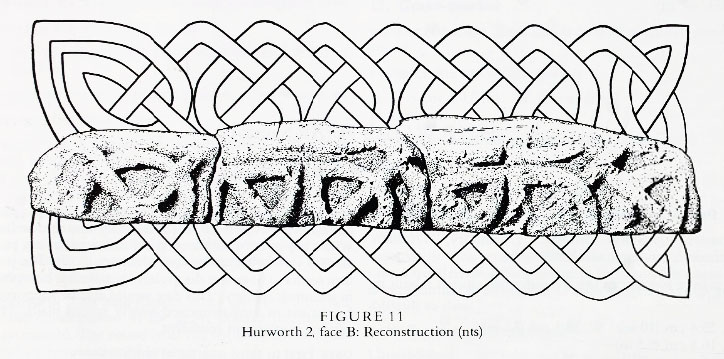
This seems more likely to be a grave-cover than a base and in type resembles the deep slab from Gainford (no. 23). Two attempts have been made to make a reconstruction (Morris 1973; Adcock 1974). Although the patterns are very similar, Adcock's reconstruction has been adopted here (Fig. 11). These widely spaced plait patterns are a feature of carvings of the ninth century and this piece is comparable with sculpture at Ripon and Hauxwell, Yorkshire, and Waberthwaite, Cumberland.
