Select a site alphabetically from the choices shown in the box below. Alternatively, browse sculptural examples using the Forward/Back buttons.
Chapters for this volume, along with copies of original in-text images, are available here.


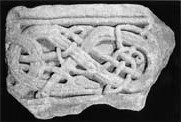
Object type: Incomplete cross-shaft [1]
Measurements: H. 40 cm (15.75 in); W. 28 > 26 cm (11 > 10.25 in); D. 14 cm (5.5 in)
Stone type: Coarse-grained, massivc yellow sandstone
Plate numbers in printed volume: Pls. 188.1039; 189.1040-1043
Corpus volume reference: Vol 1 p. 194-195
(There may be more views or larger images available for this item. Click on the thumbnail image to view.)
A (broad): A flat-band and inner roll moulding enclose one ribbon animal and part of another. The animal head is seen in profile. It has a lentoid eye, squared-off muzzle, an ear extending into interlace, and a double-outlined body which ends in a single leg and three-toed foot. There are extensions from other parts of the body as well as the ear: one could be a tail and another could be a leg, although both are the same width. These trailing extensions pass over and under each other, crossing the body of the creature, and linking in with the second ribbon animal.
B (narrow): Broken.
C (broad): Part of two panels of interlace divided by a single roll moulding. The right edge has an outer flat-band and inner roll moulding, like face A. (i) The upper panel is a large pattern E motif crossed by U-bends (Adcock 1974, 176, pl. 64b). (ii) The lower panel cannot be deciphered satisfactorily but it could be an interlaced animal, or plant-scroll.
D (narrow): The remains of two panels enclosed in a single roll moulding and divided by a horizontal roll moulding. (i) Only the bar terminal of an interlace motif survives. (ii) A crouching animal is shown in profile and enmeshed in tail and possibly ear extensions. The head appears to be rounded but no details are clear. Details of its back leg are also obscure, but the front terminates in a three-toed foot.
The manuscript origins for the animal ornament on this shaft are evident, although it is difficult to find close parallels. The crouching animal on face D could have a remote model in the Lindisfarne Gospels, fol. 211r (Pl. 261, 1421), but the clumsy round head and the weak three-toed foot look like a later development of the Lindisfarne beasts and are nearer to those of the Durham manuscript B.II.30, fol. 81v, or the Rome Gospels. The ribbon animal on A with only one clearly defined foot also appears to be a degenerate Lindisfarne beast. The head with its squared muzzle and closely clamped jaws is more like later Irish manuscripts, such as the MacDurnan Gospels. This creature has gone some way towards the Insular Jellinge type of animal which is found on the shaft from Durham (no. 1), at Aycliffe (no. 1) and Tynemouth (no. 4).
