Select a site alphabetically from the choices shown in the box below. Alternatively, browse sculptural examples using the Forward/Back buttons.
Chapters for this volume, along with copies of original in-text images, are available here.


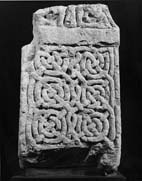
Object type: Upper part of cross-shaft [1]
Measurements: H. 48.5 cm (19.25 in); W. 33 > 31.5 cm (13 > 12.25 in); D. 18 > 16.5 cm (7 > 6.5 in)
Stone type: Medium-grained, bedded, micaceous yellow sandstone
Plate numbers in printed volume: Pl. 189.1044-1047
Corpus volume reference: Vol 1 p. 195
(There may be more views or larger images available for this item. Click on the thumbnail image to view.)
All faces are edged by a single flat-band moulding. A broad flat horizontal band separates the neck from the shaft.
A (broad): (i) Above the band are what appear to be the lower limbs of two crouching animals enmeshed in interlace and separated from one another by a vertical object, possibly a tree trunk. (ii) Below are three registers of complete closed circuit pattern F with surrounded elements, outside strands, and a central twist. The terminals have combined E and F loops.
B (narrow): (i) Above the broad flat horizontal band the curve of the cross-neck is plain. (ii) Two interlaced ribbon animals, their bodies outlined with a punch. Both have a straight front leg, and bodies which end in a curled tail. Their heads are rounded, their jaws open and curled back, and their eyes round. Their ears and tails are extended and interlace with each other and end with two frond-like terminations. (iii) Plain. (iv) A narrow band of six-cord plait.
C (broad): (i) Above the broad flat horizontal band are the remains of a plait, possibly of twelve cords. (ii) Three registers of complete closed circuit pattern F with surrounded elements, outside strands and a central twist. The terminals have combined E and F loops.
D (narrow): (i) The cross-neck is damaged, but the curve under the neck is plain. (ii) An interlace panel with one register of turned closed circuit pattern D with bar terminals. (iii) Plain, and despite its rough appearance does not seem to have been laid out for ornament.
This piece belongs to a well defined school (Introduction, p. 27), which includes 3 and 4 and the cross-shaft from Alnmouth. The animal type, however, is unique in Northumbrian sculpture and more closely related to Pictish than to English animal ornament. This relationship is seen in the coiled haunches and curled back lips (Small, Thomas and Wilson 1973, figs. 35-6). The warped panels of broad interlace have been considered to provide evidence for the use of templates in laying out designs (Adcock 1974, 264-5).
