Select a site alphabetically from the choices shown in the box below. Alternatively, browse sculptural examples using the Forward/Back buttons.
Chapters for this volume, along with copies of original in-text images, are available here.


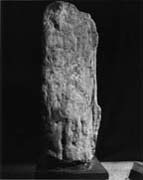
Object type: Base of shaft [1]
Measurements: H. 58 cm (22.75 in); W. 41 cm (16 in); D. 20 > 18 cm (8 > 7 in)
Stone type: Medium-grained, massive, micaceous yellow sandstone
Plate numbers in printed volume: Pl. 191.1059-1062
Corpus volume reference: Vol 1 p. 197-198
(There may be more views or larger images available for this item. Click on the thumbnail image to view.)
Base of a shaft with flat-band mouldings.
A (broad): Two side-facing figures face each other and clasp with both hands a central column with a block capital. This seems to form a double arch. They both appear to be bearded and wear short tunics. Their legs are thick and feet crude, but they are conceived on a large scale. Each figure is 14 in high. The panel is edged by a flat-band moulding.
B (narrow): No carving survives.
C (broad): A broad panel of interlace framed in a grooved moulding. The strands have been punch-outlined, and apparently form part of a ring-knot.
D (narrow): (i) A panel of eight-cord plait in a punch-outlined technique. (ii) An incised saltire ornament in a flat-band moulding.
The punch-outlined technique and shallow carving has declined in standard even from 7. The short-skirted stumpy figures can be paralleled in Anglo-Scandinavian carvings and it seems that this must be a late copy of some early original – possibly a scene such as is found on Norham 4, where two figures are divided by an architectural frame.
